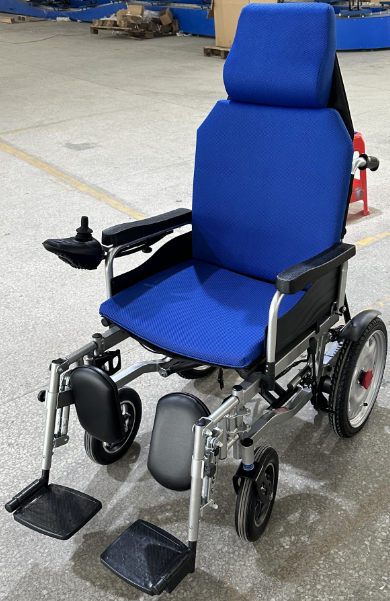
Scientific research shows that charging in a dry environment at 20℃–25℃ can extend battery life by more than 20%; conversely, long-term charging in high-temperature or cold environments will significantly shorten lifespan.
If you use your electric wheelchair for extended periods each day (e.g., more than 2 hours), daily charging is recommended.
If you only use it for short periods (e.g., several times a week), charging every 2–3 days is sufficient.
Under normal circumstances, a standard electric wheelchair can travel an average of 10 to 20 miles (approximately 16 to 32 kilometers) on a full charge.
High-performance or long-range electric wheelchairs, equipped with larger capacity lithium batteries, can even achieve a range of over 25 miles (approximately 40 kilometers).
Lithium-ion batteries are the mainstream configuration for modern electric wheelchairs.
Under normal circumstances, their lifespan is 3 to 5 years, and some can even reach over 6 years.
Lithium-ion batteries have high energy density, no memory effect, and can be repeatedly charged.
The design lifespan of a power wheelchair is generally 5-10 years; lifespan is mainly affected by the battery, motor, electronic system, tires, and the usage environment; the battery is the component most susceptible to lifespan impact, and lithium batteries are more durable than lead-acid batteries.
Suitable users of electric wheelchairs:
1. Individuals with severely limited lower limb mobility but insufficient upper limb strength
2. Individuals with neurological or muscular diseases
3. Elderly individuals with weakened mobility but some cognitive ability
4. Patients in the rehabilitation phase requiring intermittent assistance
5. Individuals with chronic diseases
Lead-acid batteries in electric wheelchairs typically need to be fully charged to 100%. However, lithium batteries do not need to be fully charged to 100% every time, as maintaining a fully charged state for a long time will cause slight wear and tear on the cells, shortening their lifespan.
For patients with severe muscle weakness or upper limb dysfunction, using traditional manual wheelchairs will lead to the dilemma of "being able to sit but unable to move" due to the lack of propulsion. Electric wheelchairs can easily replace manpower to complete various directions of travel through the electric drive system.
This article explains the battery charging method for electric wheel chairs from the aspects of charging a new wheelchair before use, power supply voltage, charging method, charger connection, charging time, etc.
Electric wheelchairs are different from ordinary wheelchairs. They need to charge their batteries to ensure normal use, so the role of batteries in electric wheelchairs is very important. In order to improve safety and battery life, take a look at: Electric wheelchair batteries Are there any precautions for charging?