

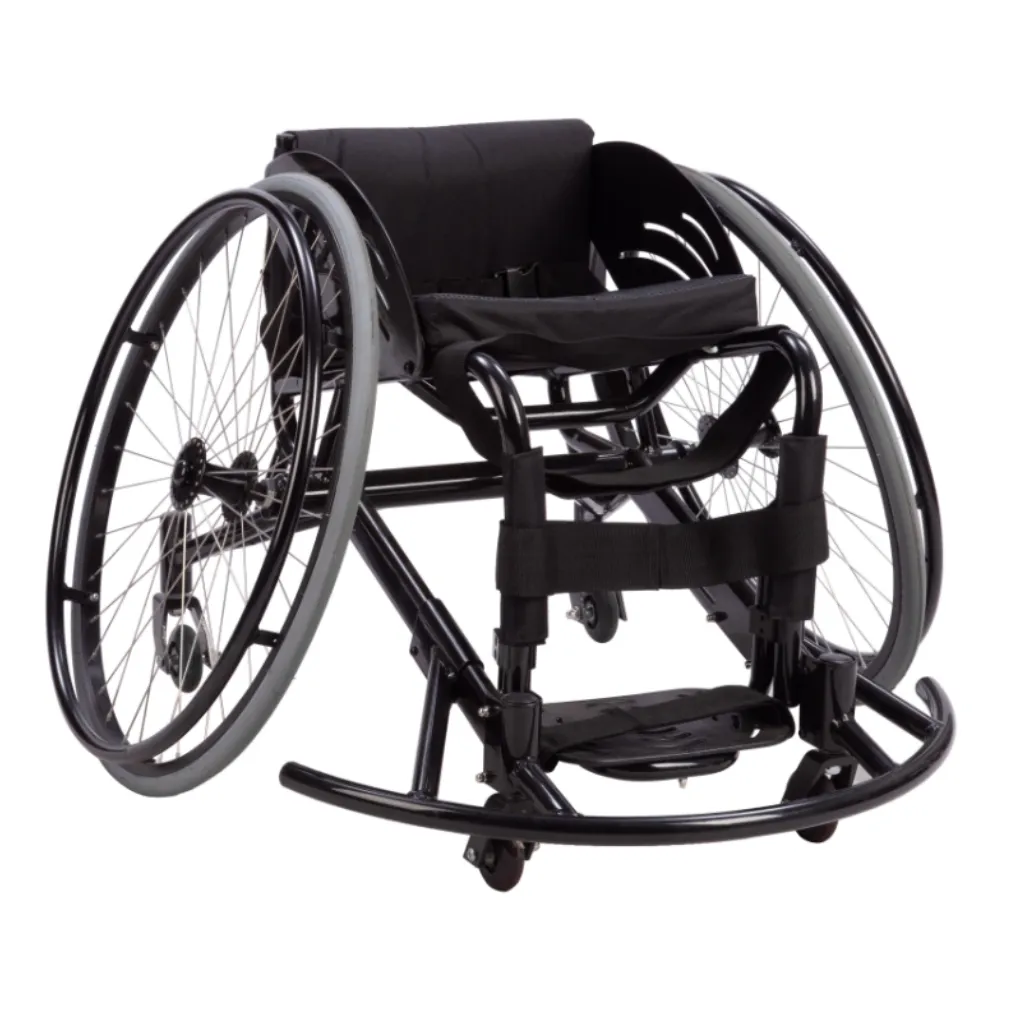
In the realm of adaptive sports, the sports wheelchair serves as a piece of core equipment. Whether observing wheelchair basketball, tennis, fencing, rugby, or other wheelchair-based disciplines, one notices a distinct feature: the wheels of sports wheelchairs almost invariably exhibit a pronounced outward angle—known as "camber." Unlike the vertical wheels found on standard daily-use wheelchairs, the two large rear wheels of a sports wheelchair splay outward, creating a stable, wide-stance posture.
Many people often wonder:
Why are sports wheelchair wheels angled? What purpose does this specific angle serve? Is it merely for aesthetics? Does it impact speed? And why don't standard wheelchairs utilize this same structural design?
Whether you are a sports enthusiast, a rehabilitation professional, a sports science student, or a newcomer just beginning to explore the world of sports wheelchairs, this article will help you gain a true understanding of the significance and functionality behind the cambered wheel design of sports wheelchairs.
Why Are Sports Wheelchairs Designed with Angled Wheels?
One of the most defining characteristics of a sports wheelchair is its large, cambered rear wheels. This structural feature is a key differentiator between sports wheelchairs and standard daily-living wheelchairs. The angling of the wheels represents a specialized design optimized for athletic performance, aimed at achieving the following objectives:
•Enhancing stability
•Minimizing the risk of tipping over
•Expanding the range of motion for pushing the wheels
•Improving turning agility
•Enhancing overall maneuverability
•Increasing the sense of integration between the athlete's body and the wheelchair
In essence, sports wheelchairs employ angled wheels to enable athletes to maintain both safety and efficiency in high-speed scenarios, during frequent directional changes, and amidst intense physical contact.
What is the Scientific Basis for the Camber in Sports Wheelchair Wheels?
The design of cambered wheels is rooted in the principles of stability mechanics derived from physics.
When the rear wheels are angled:
1. The Wheelbase Widens → Stability Increases
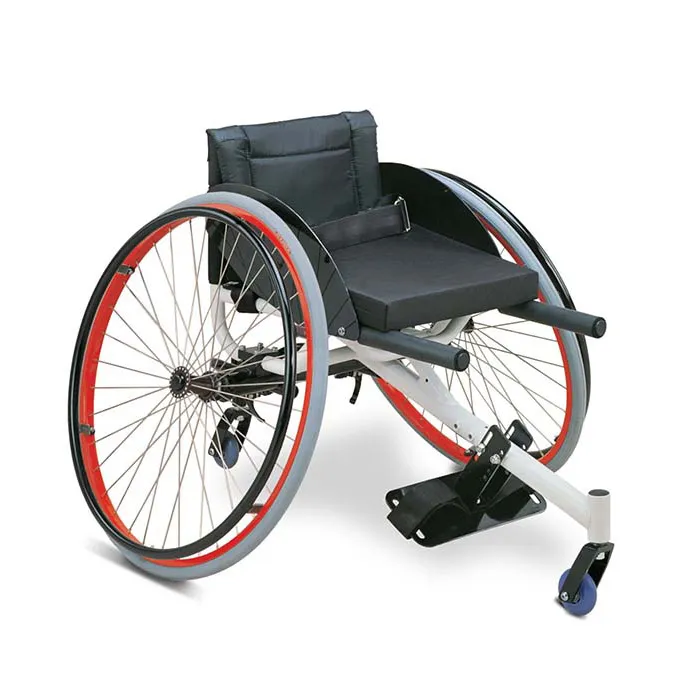
As the wheels splay outward, the overall lateral width of the wheelchair increases, thereby enhancing the stability of its center of gravity.
2. The Wheel Contact Points Shift Outward → Support Force Increases
The angle at which the wheels make contact with the ground changes, resulting in significantly stronger lateral support and resistance against tipping. 3. The center of gravity is effectively "enveloped" within the wheelbase.
The athlete's center of gravity falls within a wider structural base, thereby reducing the risk of tipping over.
These physical principles serve as the fundamental basis for the cambered wheel structure found in sports wheelchairs, and represent a core design element essential to all sports wheelchairs.
How do cambered wheels enhance the stability of a sports wheelchair?
Stability is one of the most critical performance attributes of a sports wheelchair, as athletic activities frequently involve:
•Abrupt stops
•Sharp turns
•Physical impacts/collisions
•Leaning the body to strike a ball
•Physical contact during defensive maneuvers
•Sudden reversals of direction following high-speed forward movement
The cambered structure directly improves lateral stability.
For example:
•In wheelchair basketball and wheelchair tennis, athletes must shift their bodies significantly from side to side to strike the ball or contest for possession;
•In wheelchair rugby, particularly intense physical collisions are a common occurrence;
•If a wheelchair without cambered wheels were used in these scenarios, it would be extremely prone to tipping over.
Wheel camber enables a sports wheelchair to accommodate more extreme shifts in the body's center of gravity, thereby enhancing safety.
Do cambered wheels improve the steering responsiveness of a sports wheelchair?
The answer is—yes; wheel camber significantly boosts the steering responsiveness of a sports wheelchair.
The reasons are as follows:
1. The increased wheelbase allows the chair's body to rotate more effortlessly.
A wider wheelbase generates greater lateral leverage, thereby enhancing rotational efficiency.
2. Hand-to-wheel contact feels more natural, facilitating rapid propulsion.
Wheel camber positions the wrists in a more ergonomic alignment, resulting in greater comfort during propulsion.
3. During propulsion, the wheel's contact patch can change direction more rapidly.
Cambered wheels allow for greater agility in making quick, subtle directional adjustments.
Consequently, the degree of wheel camber on a sports wheelchair directly determines:
•Steering speed
•Turning radius
•Handling precision
•Stability during abrupt stops
This also constitutes a key functional design feature that distinguishes sports wheelchairs from standard wheelchairs.
Why do sports wheelchairs require a wide wheelbase?
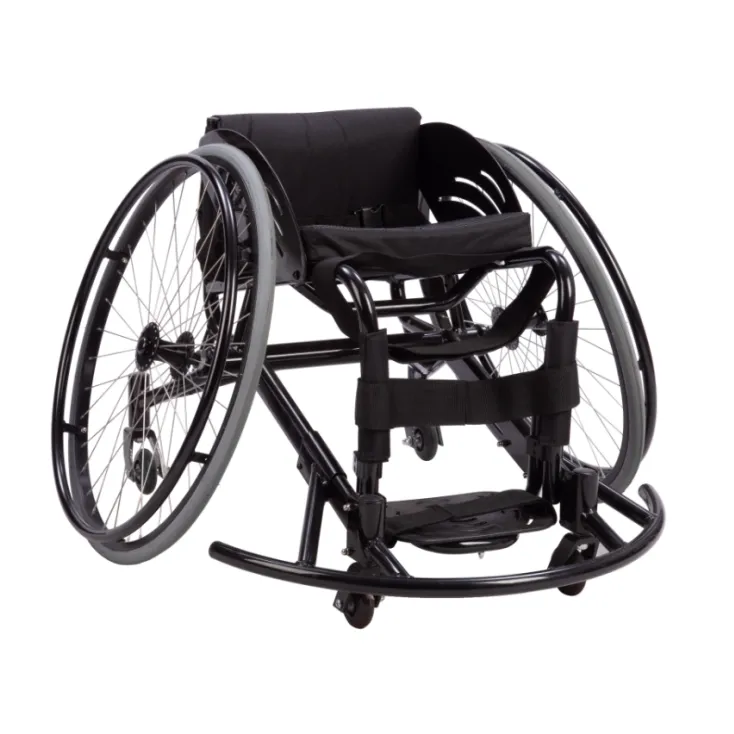
Another significant benefit of cambered wheels is that they naturally increase the overall wheelbase width. A wide wheelbase provides:
•Improved lateral balance
•Greater resistance to tipping
•More stable high-speed travel
•Better handling of body lean during intense athletic maneuvers
For all sports wheelchairs, a wide wheelbase is a crucial factor in enhancing performance; however, the resulting increase in overall width does not hinder maneuverability, as sports arenas and courts typically offer ample space.
Does wheel camber affect the speed of a sports wheelchair?
Many people mistakenly believe that wheel camber slows a wheelchair down. In reality:
•Small degrees of camber have a negligible effect on speed.
•Large degrees of camber may slightly increase tire friction, but they yield a significant improvement in stability.
•In the context of sports, stability is far more critical than sheer straight-line speed.
Wheelchair sports are not merely races; they place a greater emphasis on:
•Agility
•Turning capability
•Stability
•Rapid responsiveness
Consequently, cambered wheels do not reduce a sports wheelchair's effective speed during play; rather, they enhance overall athletic efficiency.
Do different sports require different wheel camber angles?
Yes, different sports call for different camber angles:
1. Wheelchair Basketball: Maximum Camber
Designed to maximize lateral stability and provide protection against collisions.
2. Wheelchair Tennis: Significant Camber
Required to facilitate rapid lateral movement and continuous turning.
3. Wheelchair Fencing: Minimal Camber
Because the sport primarily involves linear movements—attacking and defending in a straight line.
4. Wheelchair Rugby: Moderate-to-High Camber
Necessary to provide sufficient stability and aid in recovering balance after impact.
As a result, wheel camber stands as one of the most critical parameters when customizing a sports wheelchair.
Why do standard wheelchairs not utilize a cambered design?
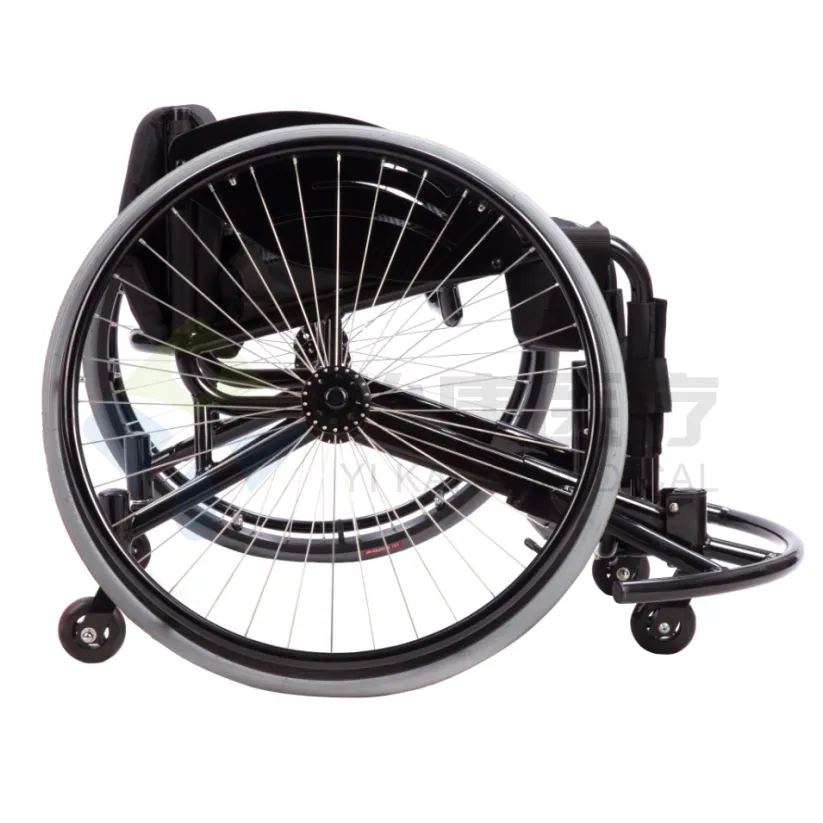
Although cambered wheels offer numerous advantages, standard wheelchairs do not adopt this design for the following reasons:
1. Indoor Space Constraints
Camber increases the overall width of the wheelchair, making it unsuitable for navigating narrow environments.
2. Primary Focus on Straight-Line Propulsion Efficiency
Users of standard wheelchairs often need to propel themselves over long distances; camber increases tire wear and friction, making propulsion less efficient.
3. Standard Wheelchairs Do Not Require Intense Athletic Performance
They do not involve the extreme lateral movements or physical collisions inherent in sports.
4. Cambered Structures Are More Complex and Costly
This design is typically reserved for individuals with specific high-performance athletic requirements.
Therefore, cambered wheels are a feature specifically engineered for sports wheelchairs, rather than for standard wheelchairs intended for daily use.
Do cambered wheels make a sports wheelchair harder to push?
Many beginners worry that cambered wheels are difficult to push, but the reality is quite the opposite:
•Cambered wheels create a more natural contact angle between the hands and the push rims.
•The pushing motion aligns more closely with the natural trajectory of the arms.
•They offer greater stability, making the wheelchair easier to control while pushing.
From an ergonomic standpoint, cambered wheels place less strain on the hand joints compared to vertical wheels, making them particularly well-suited for sports scenarios that involve extensive pushing.
How does the camber angle affect an athlete's safety?
Cambered wheels constitute one of the most critical safety features of a sports wheelchair:
•They prevent tipping over during high-speed turns.
•They prevent loss of balance during intense physical contact.
•They provide support for the athlete's lateral body movements.
•They increase the wheelchair's overall traction.
•They form a protective "V-shaped structure" during collisions.
A sports wheelchair without cambered wheels offers virtually no safety assurance during intense athletic activity.
How should one choose the appropriate camber angle based on physical attributes?
A larger camber angle is not necessarily better; the choice should be based on the following criteria:
•Shoulder width
•Arm length
•Upper body strength
•The specific type of sport being played
•Level of handling proficiency
•Individual requirements regarding stability
General recommendations:
•Beginners: 8° to 12°
•Advanced Athletes: 12° to 18°
The appropriate camber angle allows a sports wheelchair to perform at its absolute maximum potential.
How is the camber angle on a sports wheelchair adjusted and secured?
Sports wheelchairs utilize:
•Reinforced frames
•Specially designed side panels
•Strengthened axle structures
The camber angle is typically set during the manufacturing or customization process and is secured using:
•Fixed-angle forks
•Axle mounts with specific angles
•Welded structural components
Because sports wheelchairs must withstand high-intensity usage, the camber angle must remain rigidly fixed and resistant to deformation.
Does the cambered design increase maintenance costs?
Although the structure of cambered wheels is more complex, maintenance is quite simple and requires only the following:
•Regular inspection of the wheel bearings
•Ensuring that the axle angles remain tight and secure
•Regular replacement of worn tire treads
•Maintaining correct tire pressure
The camber angle itself does not impose any additional maintenance burden.