

What is a joystick-controlled electric wheelchair? How does the joystick work? A detailed look at control, speed, and safety.
Amidst the global trend of an aging population and rising demand for rehabilitative healthcare, electric wheelchairs are becoming essential mobility tools for an increasing number of people with limited mobility. For many elderly users, individuals with neurological disorders, paraplegics, and those with long-term mobility impairments, the electric wheelchair is far more than a simple assistive device; it serves as a "second pair of legs," playing a vital role in enabling mobility, independent living, social interaction, and the maintenance of quality of life.
Market research on global rehabilitation equipment indicates that the electric wheelchair market exceeded $7 billion in 2025 and is projected to maintain a compound annual growth rate (CAGR) of 7% to 9% over the next five years. As the market expands, user expectations are rising. Beyond considerations such as range, battery life, weight, and comfort, increasing attention is being paid to a core—yet often overlooked—component: the joystick.
First-time users often wonder: How can a small joystick control the entire wheelchair’s forward and backward movement, turning, acceleration, and even braking? Is it truly safe? What happens if the joystick malfunctions? Why do high-end models offer such smooth handling, while others feel sluggish or exhibit a jerky, "nodding" motion upon starting?
These questions highlight a long-standing pain point in the industry: many buyers focus solely on the wheelchair itself while overlooking the importance of the control system.
In reality, a poor control experience has become a major factor affecting user satisfaction.
Surveys of assistive mobility device users show that control responsiveness and steering precision rank among the top five factors influencing satisfaction, accounting for over 52% of responses. For users with limited upper-body strength or reduced fine motor skills, the joystick system's sensitivity, damping feel, and error tolerance directly determine whether they can truly operate the wheelchair independently. Imagine this scenario: an elderly person is driving an electric wheelchair into a narrow elevator. If the joystick's response is overly sensitive, a slight nudge could cause a collision with the wall; conversely, if the response is too sluggish, it might lead to under-steering, requiring repeated adjustments to successfully enter the elevator. Such control errors not only detract from the user experience but can also pose safety risks in complex environments.
Therefore, to understand modern electric wheelchairs, one must first grasp the concept of the joystick-controlled electric wheelchair.
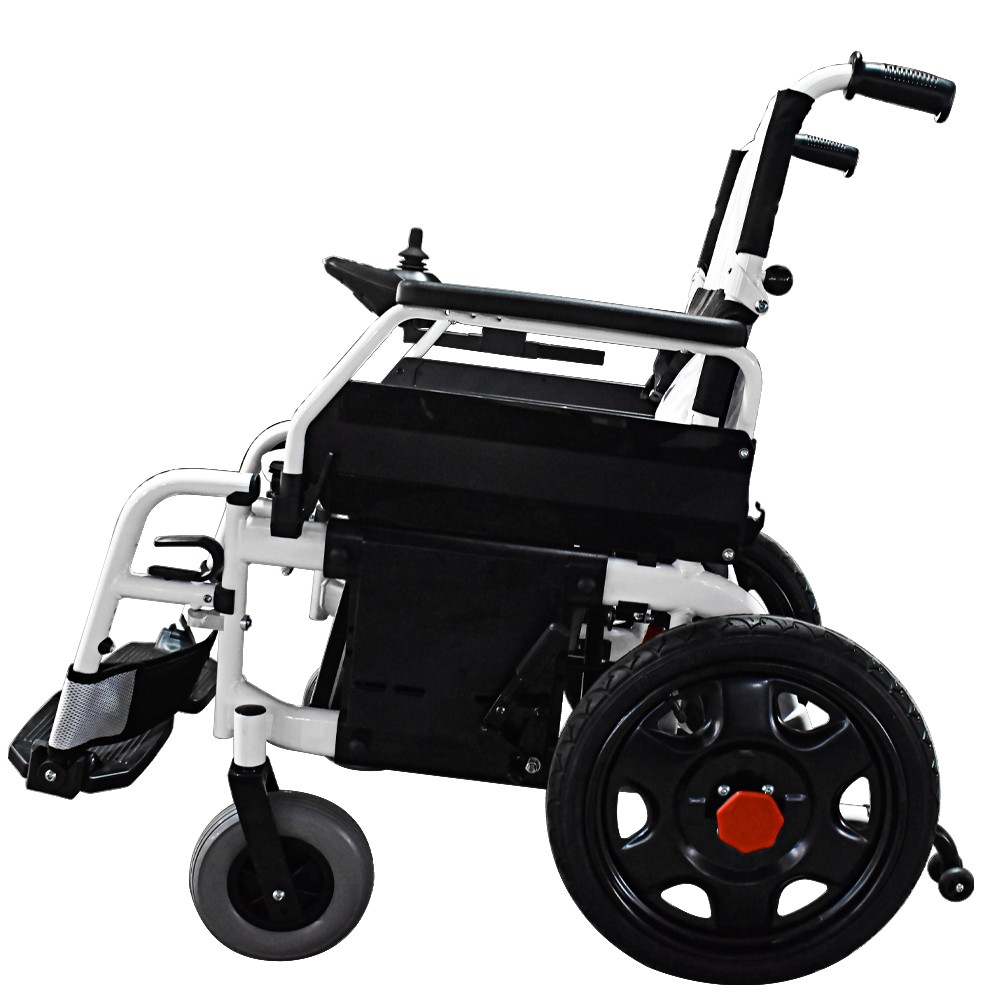
What is an electric wheelchair with a joystick?
A joystick-controlled electric wheelchair is one that uses an electronic joystick as the primary input device to control movement direction, speed, and steering angle. Unlike traditional manual wheelchairs, which rely on the user pushing the rims with their arms, these wheelchairs utilize a motor-driven system for movement, requiring the user only to input commands via the joystick.
Simply put, the joystick serves as the core human-machine interface between the user and the wheelchair.
The vast majority of electric wheelchairs on the market today employ joystick control systems. These are typically mounted at the front of the armrest and can be positioned on either the left or right side, depending on user preference. While some high-end rehabilitation-grade models support alternative interfaces—such as chin controls, head controls, or touchscreens—the joystick remains the most mainstream solution, as it strikes the optimal balance between cost, reliability, ease of learning, and control precision.
How exactly does an electric wheelchair joystick work?
From a technical standpoint, the joystick system consists of four main components: the mechanical joystick itself, a sensor module, a controller, and the drive motors.
First is the mechanical joystick unit. When a user pushes the joystick, they are essentially providing a two-dimensional directional input. The joystick can move forward, backward, left, right, and diagonally; the extent of its displacement represents the input intensity, while the direction indicates the intended movement path.
The second component is the sensor module, which acts as the true core of the system.
Modern electric wheelchair joysticks typically utilize Hall-effect sensors or potentiometers. Their function is to convert mechanical displacement into electrical signals. For instance, when a user nudges the joystick forward, sensors detect the displacement and convert it into a corresponding voltage signal—shifting, say, from 2.5V to 3.1V; pushing it to the left generates a different set of coordinate signals.
In terms of control logic, the joystick does not simply output "forward" or "backward" commands; instead, it outputs real-time positional data within a two-dimensional coordinate system.
Think of it in terms of X and Y axes:
The X-axis controls left-right steering,
The Y-axis controls forward-backward movement.
When the joystick is in the center position, the system registers zero input, and the power wheelchair remains stationary. Pushing the joystick forward increases the Y-value, causing the wheelchair to move forward; pushing it to the left alters the X-value, prompting the system to create a speed differential between the left and right wheels to execute a turn.
This brings us to the third component: the controller.
The power wheelchair controller is essentially an embedded computing system—the "brain" of the wheelchair. It continuously reads signals from the joystick and uses algorithms to calculate the power output required for the left and right drive wheels.
This is the most ingenious aspect of joystick-controlled electric wheelchairs: they do not change direction via mechanical steering linkages but instead rely on differential speed control between the left and right motors.
For example, when the user moves straight ahead, both motors output the same speed—say, 100 revolutions per minute (RPM)—resulting in straight-line travel.
When the user turns left, the controller might maintain the right wheel at 100 RPM while slowing the left wheel to 40 RPM. Due to this speed disparity, the wheelchair naturally veers to the left.
If the user pushes the joystick fully to the left, the controller may even reverse the left wheel while driving the right wheel forward, enabling the wheelchair to spin in place. This differential steering capability is key to the wheelchair's ability to maneuver flexibly in tight spaces.
The fourth component is the drive motor.
The vast majority of electric wheelchairs utilize a dual-motor drive configuration—one motor on each side—typically with power ratings between 180W and 500W. The controller adjusts motor power output using PWM (Pulse Width Modulation) speed control technology, ensuring smooth acceleration and deceleration.
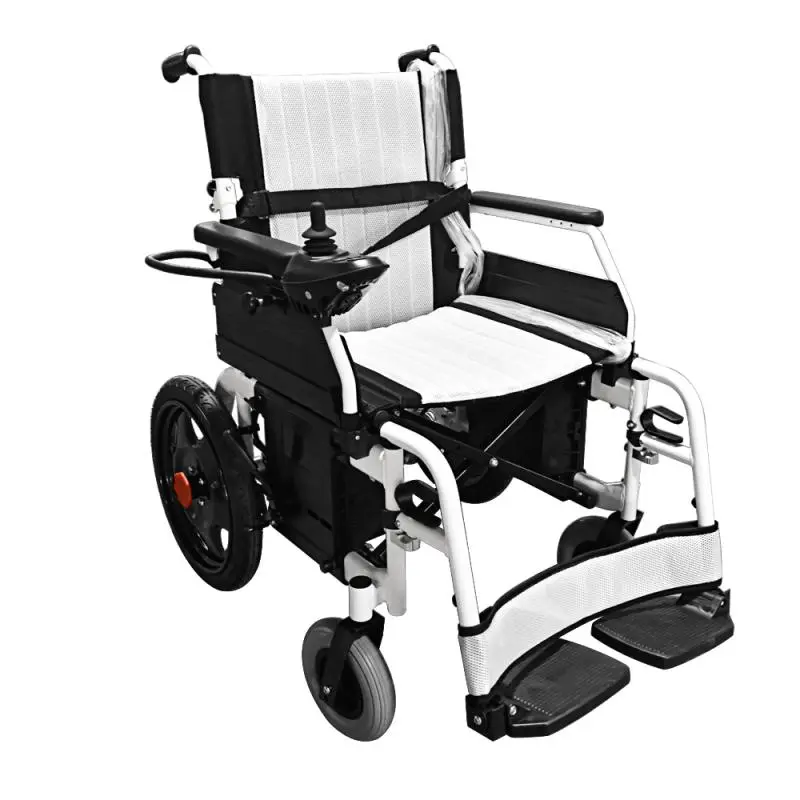
Why do high-end electric wheelchairs offer smoother handling?
The answer lies in the control algorithms.
Entry-level power wheelchairs often employ simple linear control: the motor's power output corresponds directly to the extent of the joystick's movement. This method is low-cost but prone to jerky movements.
High-end power wheelchairs, however, utilize acceleration curve control, filtering algorithms, and dynamic response compensation. For instance, when the system detects a sudden, large movement of the joystick, it does not immediately output full power; instead, it employs progressive acceleration.
This is crucial.
A significant portion of electric wheelchair users are elderly individuals or patients with neurological impairments who are highly sensitive to sudden acceleration. Data shows that over 37% of elderly users report feeling significantly unsafe due to sudden acceleration.
Therefore, a high-quality joystick-controlled electric wheelchair must address three key issues: precise control, smooth speed transitions, and safety and reliability.
Next, let’s discuss speed control.
When purchasing electric wheelchairs, many consumers simply ask, "How fast can it go?" However, the industry prioritizes speed controllability over absolute top speed.
Currently, the top speed for most consumer electric wheelchairs falls within the 6 to 10 km/h range. This range was not chosen arbitrarily; it was determined based on a combination of safety, regulatory requirements, and user comfort.
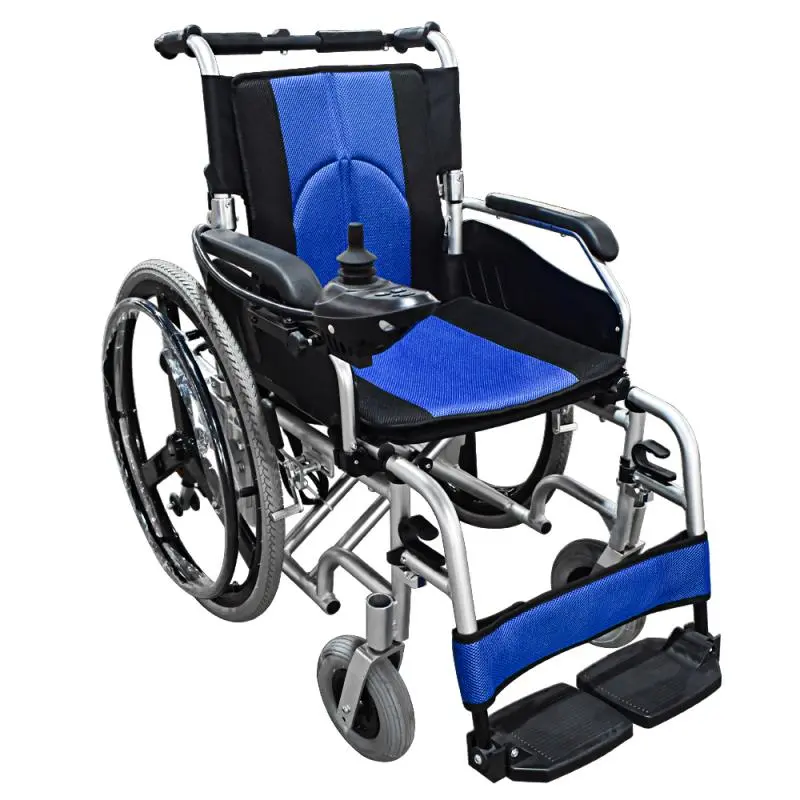
Why aren't electric wheelchairs designed to go faster?
Because increasing speed significantly raises the level of risk.
Consider a power wheelchair carrying a 120 kg load: at 6 km/h, the kinetic energy remains manageable. If the speed increases to 12 km/h, the kinetic energy quadruples. Both the risk of collision and the braking distance increase substantially.
Consequently, modern power wheelchairs typically offer multiple speed modes, such as:
Low-speed mode: 1–3 km/h
Medium-speed mode: 3–6 km/h
High-speed mode: 6–10 km/h
Low-speed mode is suitable for indoor environments, hospitals, elevators, and tight spaces, while high-speed mode is ideal for flat outdoor surfaces.
High-quality joystick systems usually support proportional speed control; the further the user pushes the joystick, the higher the speed. This design makes control feel more natural, similar to an automobile's accelerator pedal.
Safety is the most critical aspect of joystick-controlled electric wheelchairs.
A sophisticated joystick control system typically incorporates multiple layers of safety protection.
The first layer is "dead zone" protection.
A small dead zone is usually set at the center of the joystick to prevent accidental movement caused by slight hand tremors. This is particularly important for users with Parkinson's disease or hand tremors.
The second layer is automatic braking.
Most electric wheelchairs utilize electromagnetic braking systems. When the joystick returns to the neutral (center) position, the controller immediately cuts power to the drive motors and engages the electromagnetic brake, bringing the wheelchair to a quick and stable stop.
The third layer is an accidental-activation prevention design.
Some high-end joystick systems require a long press to power on, preventing the chair from starting accidentally.
The fourth layer is anti-roll protection on slopes.
This is a crucial safety feature often overlooked by users. Without braking assistance, power wheelchairs can easily roll backward when stopped on an incline. High-quality controllers automatically increase braking force when the chair stops on a slope.
The fifth layer is fail-safe protection.
If the joystick signal becomes abnormal—due to signal drift, a broken connection, or a damaged sensor—the controller typically enters protection mode immediately and cuts off output.
From an industry perspective, the reliability of the joystick system is becoming a key benchmark for power wheelchair quality. An increasing number of manufacturers realize that what users truly rely on is not just the frame, but the control experience itself.
Take Yikang Medical® as an example: in our power wheelchair designs, we focus not only on power, battery life, and structural integrity but also increasingly on the ergonomic optimization of the control system. Details such as joystick layout, button accessibility, feedback sensitivity, and speed-adjustment logic for various scenarios may seem minor, yet they directly impact the user's long-term experience. For rehabilitation assistive devices, true product competitiveness often stems from meticulous optimization of details rather than simply stacking specifications.
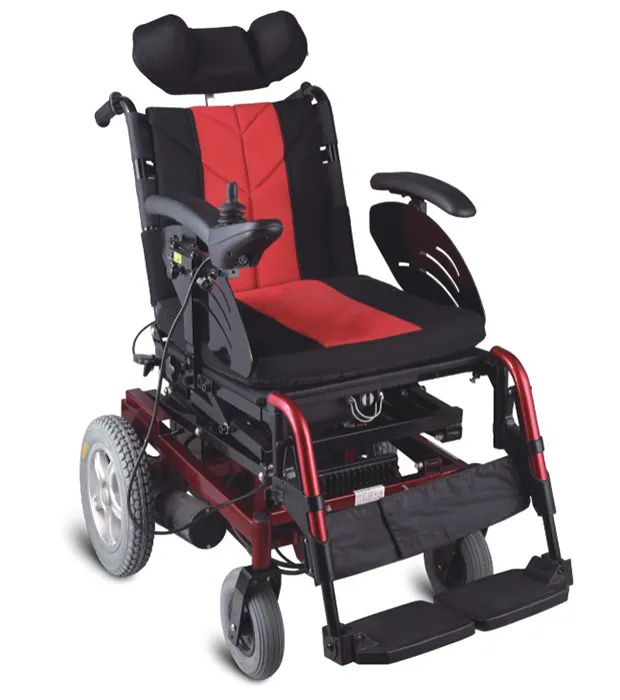
FAQ: Common Questions About Electric Wheelchair Joysticks
Q1: Do all electric wheelchairs have joysticks?
Most do. The joystick is currently the most common control method for power wheelchairs.
Q2: Can the electric wheelchair joystick be mounted on either the left or right side?
Most can. Many electric wheelchairs support mounting on either the left or right side.
Q3: Can the power wheelchair still be used if the joystick is broken?
Generally, no; since the joystick is the primary input device, it requires repair or replacement.
Q4: Is higher joystick sensitivity always better?
Not necessarily. Excessive sensitivity can compromise safety; the key is precise and smooth responsiveness.
Q5: Does the power wheelchair joystick require maintenance?
Yes. You should prevent water ingress, impacts, and dust accumulation, and regularly check signal stability.