
Wheelchair rugby is a highly physical, fast-paced, and high-impact sport. The equipment that underpins the core experience of this sport is the specially designed *rugby wheelchair*.
Many people unfamiliar with the sport often ask: "What exactly does a rugby wheelchair look like?"
Unlike standard daily-use wheelchairs, a rugby wheelchair is not merely a mobility aid; rather, it is a piece of specialized athletic equipment engineered for competition, collision, propulsion, defense, and agile movement.
If you are looking for a truly comprehensive explanation to help you understand "what a rugby wheelchair actually looks like," this article will provide you with a detailed breakdown of its structure.
The following sections will analyze the visual characteristics and structural design of the rugby manual wheelchair in depth, from the perspective of specialized sports equipment.
What Unique Features Define the Overall Appearance of a Rugby Wheelchair?
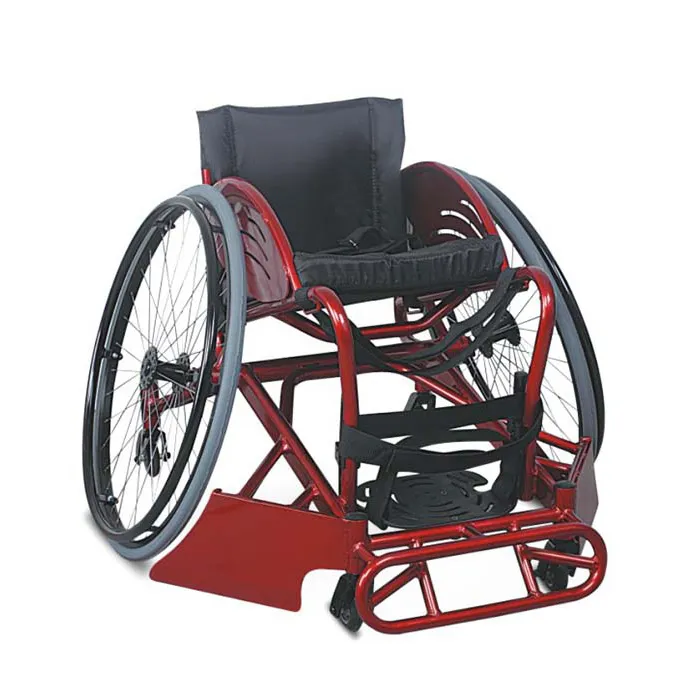
Visually, a rugby wheelchair differs drastically from a standard manual wheelchair. It resembles a piece of athletic gear more than it does a mobility device. Its defining visual characteristics typically include:
•A robust metal frame built to withstand impact
•Wheels set at a wide outward angle (commonly referred to as "cambered wheels")
•A reinforced front bumper designed for collision
•Wheel guards installed to prevent opponents from snagging the wheels
•A protective footrest enclosure
•A compact, stable chassis design with a low center of gravity
All of these visual features revolve around one core objective:
To maintain stability and agility during high-speed movement, while simultaneously withstanding intense physical contact and wheelchair-to-wheelchair collisions.
Consequently, although it is technically a wheelchair, its appearance aligns more closely with that of "competitive athletic gear"—exuding an aura of power, impact resistance, and structural integrity.
Why Do Rugby Wheelchairs Feature a Reinforced Front Bumper?
Among all the distinctive features of a rugby wheelchair, the "front bumper" stands out as one of the most conspicuous and iconic design elements. The front bumper is a curved metal guard frame mounted at the front of a wheelchair rugby chair, designed to:
•Absorb impacts
•Prevent damage to the front of the wheelchair
•Protect the user's feet
•Prevent dangerous "hooking" maneuvers between wheelchairs
Wheelchair rugby matches are highly physical and full of contact; collisions between wheelchairs occur constantly. Without a reinforced structural design, it would be impossible to participate in the sport safely.
Why must the front bumper on a wheelchair rugby chair be exceptionally sturdy?
Because the front bumper must be capable of:
•Pushing opponents
•Withstanding impacts
•Bringing high-speed motion to a halt
•Enduring forces applied from various directions
•Preventing "hooking" (illegally snagging an opponent's wheelchair)
Consequently, front bumpers are typically fabricated from metals possessing high strength and excellent toughness, utilizing welded, reinforced structures to ensure they do not detach or deform during a match.
In summary:
The front bumper is not merely an aesthetic feature; it is a critical safety component at the very core of a wheelchair rugby chair.
Why do wheelchair rugby chairs feature wheel guards? What do they look like?
Another distinctive visual component of a wheelchair rugby chair is the wheel guard.
A wheel guard is a protective shield that covers the outer circumference of the wheel, typically constructed from metal or highly durable composite materials.
Why are wheel guards necessary for wheelchair rugby chairs?
•To prevent opponents from grabbing the wheel spokes (an illegal maneuver during gameplay)
•To protect the wheels from contact-related damage
•To minimize the risk of wheelchairs becoming entangled with one another
•To enhance overall safety
•To ensure that impacts are more controlled and do not result in dangerous snagging or tearing actions
Wheel guards not only lend a more professional appearance to the wheelchair rugby chair but also reflect the sport's strong emphasis on safety and adherence to the rules.
In terms of form, wheel guards are typically curved to fit snugly against the wheels, giving the entire wheelchair rugby chair the appearance of a fully enclosed, specialized piece of athletic equipment.
Why are the wheels on a wheelchair rugby chair set at a "cambered" angle? What is the functional purpose of this design?
"Cambered wheels" constitute one of the most immediately recognizable features of a wheelchair rugby chair.
This design involves tilting the wheels outward, creating a wide stance similar to that seen on specialized wheelchairs used for sports such as basketball or tennis.
Why is this outward tilt—or camber—necessary?
1.Increased Lateral Stability
Cambered wheels increase the overall width of the rugby manual wheelchair and lower its center of gravity, enabling it to better withstand impacts.
2.Enhanced Steering Responsiveness
The cambered structure allows the rugby manual wheelchair to execute rapid, highly agile turns, keeping pace with the high-speed rhythm of the game.
3.Reduced Risk of Tipping
A wider wheelbase significantly reduces the risk of tipping over sideways.
4.Improved Maneuverability
During physical contact, forward drives, and maneuvers around opponents, cambered wheels allow athletes to move with greater agility and speed.
Consequently, the wheel camber is one of the most visually distinctive and specialized features of a rugby wheelchair, serving as the core source of its maneuverability.
What does the foot protection structure on a rugby wheelchair look like? Why is it so important?
Given the frequent collisions inherent in wheelchair rugby, the feet are the body parts most vulnerable to external forces. Therefore, rugby wheelchairs feature specially designed foot protection structures.
Foot protection structures typically include:
•A reinforced front footplate
•A wraparound metal guard
•A foot guard integrated directly into the front bumper
Why is foot protection necessary for rugby wheelchairs?
•To prevent opponents from striking the feet
•To prevent the feet from slipping out the front of the wheelchair during a collision
•To prevent the feet from becoming entangled in an opponent's wheels
•To provide the athlete with stable postural support
The foot protection structure is also a key visual element of the rugby manual wheelchair's design; typically positioned at the very front of the chair and integrated with the front bumper, it forms a robust, highly protective assembly.
What are the different types of rugby wheelchairs? How do their appearances differ?
Rugby wheelchairs are generally categorized into two types:
•Offensive Wheelchair Rugby Chairs
•Defensive Wheelchair Rugby Chairs
What does an offensive rugby wheelchair look like?
Offensive rugby wheelchairs feature:
•A reinforced front bumper
•Smooth, continuous body surfaces (to minimize snagging)
•Wrap-around wheel guards
•A shorter, lighter, and more agile frame
•Greater steering maneuverability
These features are designed to:
•Quickly break through opponents' defenses
•Avoid getting hooked or entangled
•Enhance agility and speed of movement
Key Point: Offensive rugby manual wheelchairs "appear sleeker and more streamlined."
What does a defensive rugby wheelchair look like?
Defensive rugby wheelchairs have a more robust appearance and typically feature:
•Sturdy, flared side wings
•A wider frame
•A more stable wheelbase
•Powerful "catching" structures (designed to block opponents)
Their objective is not to break through, but to block and contain.
Key Point: Defensive rugby manual wheelchairs "appear wider, sturdier, and more confrontational."
What are the visual characteristics of a rugby wheelchair's seating structure?
To withstand the intensity of the sport, the seating must be stable and secure.
The seating design typically includes:
•A deep-set seat configuration
•Multi-point fastening seatbelts or leg straps
•A low center of gravity seating position
•A wrap-around seat frame
•A stable hand-propulsion zone
•A sturdy backrest structure
Visually, the seating resembles a competitive sports seat rather than the standard cushion design found on everyday wheelchairs.
What materials are used in rugby wheelchairs, and what kind of texture does their appearance convey?
Rugby wheelchairs typically utilize:
•High-strength aluminum alloys
•Titanium alloys
•High-tensile steel
•Impact-resistant composite materials
Because they must withstand powerful impacts, their appearance features:
•A metallic aesthetic
•Robust, strong lines
•Reinforced weld points
•Impact-resistant surfaces
•The visual aesthetic of professional sports equipment
Overall, they look both professional and sturdy, exuding a distinct competitive character.
Why does a rugby wheelchair, as a whole, look more like a piece of "sports equipment"?
Because its appearance and structure are designed exclusively for competitive play, featuring:
•Cambered wheels
•Reinforced front bumper
•Wheel guards
•Protective footplates
•Robust frame
•Compact body
It prioritizes neither comfort nor daily-living utility, focusing instead on:
•Impact resistance
•High-speed maneuverability
•Rapid turning capabilities
•Competitive agility and safety
Visually, a rugby wheelchair resembles—even more closely—a "dedicated competitive machine."
What kind of company is Yikang Medical, and why should I choose you as my supplier?
Yikang Medical is a professional manufacturer and supplier based in China, specializing in hospital rehabilitation and nursing equipment. With roots dating back to 2010 in hardware and machinery production, we expanded into medical equipment manufacturing in 2014. Today, we operate as a reliable OEM factory for multiple global brands, offering high-quality products such as manual and electric hospital beds, wheelchairs, and mobility aids.