
Among assistive mobility devices, the 4-wheel rollator walker is highly popular among home and care facility users due to its stability, ease of operation, and wide applicability. Many users who are purchasing or researching walkers ask a crucial question: "Does a 4-wheel rollator have a seat?"
This seemingly simple question involves the structural design of the 4-wheel rollator, functional differences, user needs, usage scenarios, weight-bearing standards, and distinctions from other walkers. Therefore, to correctly understand whether a 4-wheel rollator walker is equipped with a seat, a comprehensive understanding of its overall structure and types is essential.
This article will answer this question from a professional perspective, helping consumers, caregivers, and family members fully grasp the design features and seat configurations of 4-wheel rollators.
What is the basic structure of a 4-wheel rollator?
To determine whether a 4-wheel rollator has a seat, it is necessary to first understand its basic structure.
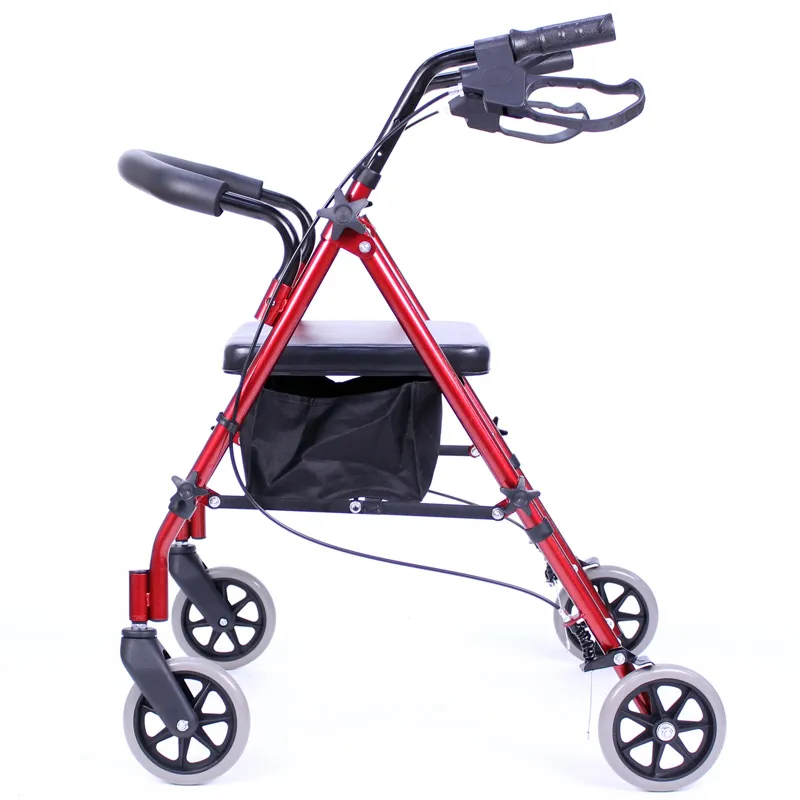
A typical 4-wheel rollator consists of the following components:
• Four wheels (front wheels swivel, rear wheels fixed or braked)
• Main frame (aluminum alloy or steel tubular structure)
• Braking system (handbrake or parking brake)
• Height-adjustable grab handles
• Storage baskets or bags (some models)
• Seat (some models)
• Backrest straps (some models)
As can be seen from the structure, the "seat" is an optional module, not a standard feature on all 4-wheel rollators.
Do 4-wheel rollators usually come with a seat?
Most 4-wheel rollators come with a seat, but not all.
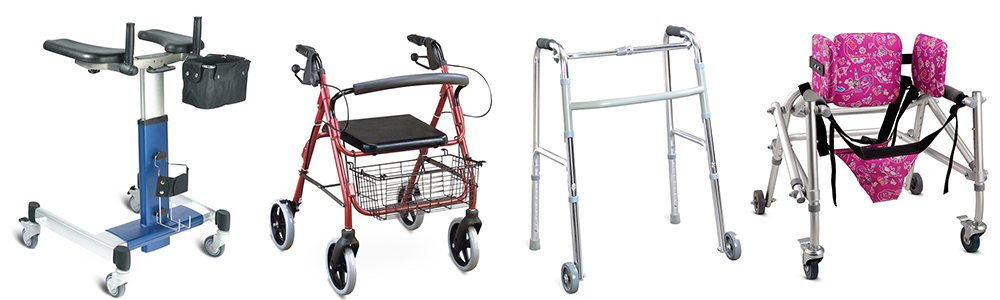
Based on mainstream market types, 4-wheel rollators are generally divided into two main categories:
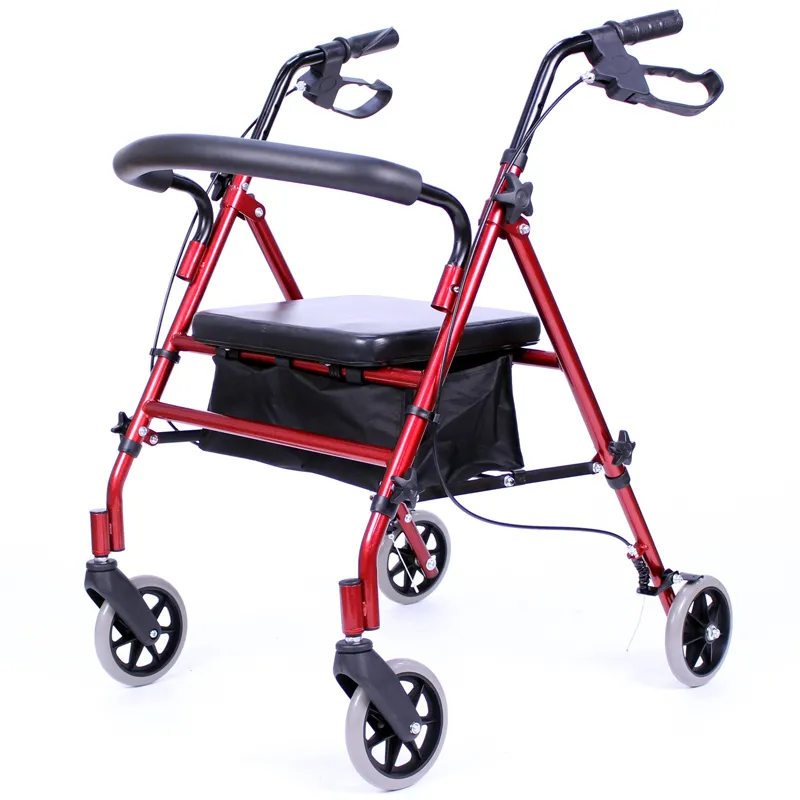
1. 4-wheel rollators with seats (most common)
This type of 4-wheel rollator features:
• A fixed seat cushion
• A foldable soft cushion
• Or a hard panel seat
In addition, it usually comes with:
• A backrest strap
• A storage basket (usually located under the seat)
This type of walker is most widely used in hospitals, nursing homes, and homes.
2. 4-wheel rollators without seats (relatively rare)
This type is lighter and is mainly used for:
• Users who only need walking assistance
• Users who do not need rest stops during the journey
• Users who engage in more outdoor activities
• Users with stricter weight requirements
Therefore, determining whether a 4-wheel rollator walker has a seat cannot be generalized; it depends on the specific model.
Why do some 4-wheel rollators have seats while others do not?
The main reasons include the following:
1. Different design purposes
4-wheel rollators with seats are primarily used for:
• Users who need to stop and rest while walking
• Daily walking indoors and outdoors
• Elderly people with weaker physical strength or who tire easily
4-wheel rollators without seats emphasize:
• Ultra-lightweight
• Foldable and portable
• Short-term walking assistance
The two designs cater to different user needs.
2. Different Product Positioning
Products with seats belong to:
• Multifunctional walking aids
• Suitable for long-term use
• Meeting the needs of patients or the elderly for continuous movement
Products without seats belong to:
• Minimalist walking aids
• Sports assistive tools
• Portable walking devices
3. Different Usage Environments
Products with seats are more suitable for:
• Long corridors
• Medical institutions
• Public places such as shopping malls and parks
• Moving between indoor rooms
Products without seats are more suitable for:
• Short-distance movement
• Confined spaces
• Users who frequently fold and store their vehicles
4. Different Load-Bearing Structures
The presence of a seat requires:
• A more stable main frame
• A wider wheelbase
• A stronger load-bearing structure
Walking aids without seats are lighter, allowing for a simpler structure.
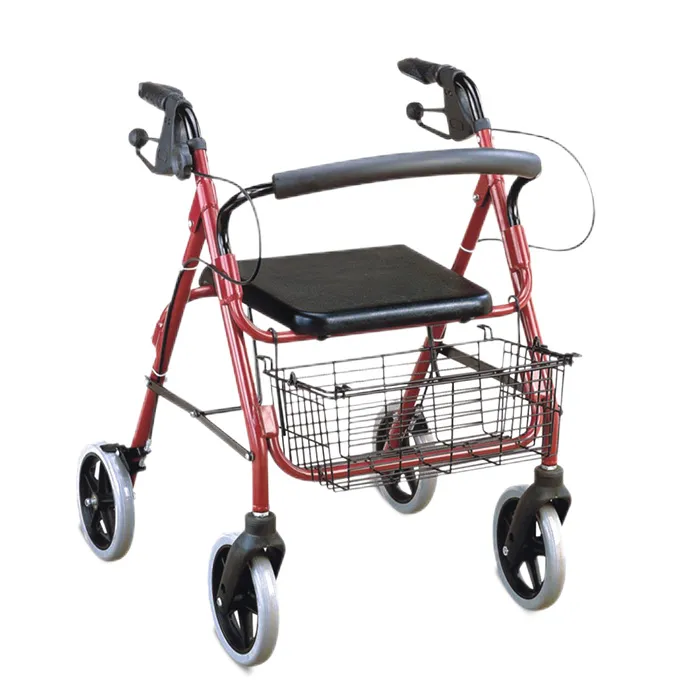
How to determine if a 4-wheel rollator has a seat?
When purchasing or using a 4-wheel rollator walker, you can determine this using the following methods:
1. Check the product image
4-wheel rollator walkers with seats have a clearly visible seat cushion or panel.
2. Check the instruction manual or specification sheet
It usually indicates:
• With a seat
• Seat material
• Weight capacity
• Backrest configuration
3. Check the storage basket location
Most models with seats have the storage basket located under the seat.
4. Check for a backrest strap (backrest)
Almost all walking aids with seats are equipped with a backrest strap to prevent the rider from leaning back while seated.
5. Check the maximum weight capacity
Walking aids without seats have a relatively lower weight capacity, while those with seats usually have a higher weight capacity to support the weight of the rider in a seated position.
Which users are more suitable for a 4-wheel rollator with a seat?
A 4-wheel rollator walker with a seat is suitable for the following users:
1. Elderly people who tire easily
They find long walks difficult to endure and therefore need to be able to sit down and rest frequently.
2. Patients in rehabilitation
Post-operative patients, orthopedic rehabilitation patients, etc., need to avoid excessive standing.
3. People with insufficient lower limb strength and poor balance
They need walking assistance and also need to sit down frequently.
4. People who need to move around outdoors for extended periods
For example, elderly people in parks, shopping malls, or community activities.
5. People who need to move between rooms and sit down to change clothes or tidy up
A 4-wheel rollator walker with a seat can be used not only for movement but also as a temporary seat.
Is a 4-wheel rollator with a seat safe?
Generally speaking, a 4-wheel rollator walker with a seat is safe, but it must be used correctly.
The following are its safety features:
1. With a braking system
The user should lock the brakes before sitting to prevent movement.
2. With a backrest (some models)
Prevents the body from leaning backward and falling backward.
3. The seat structure meets load-bearing standards
Common load-bearing capacities:
• 100kg
• 120kg
• 136kg, etc.
Users should ensure their weight is within a safe range.
4. Wider wheelbase
Enhances stability and improves anti-rollover capability.
What should you pay attention to when choosing a 4-wheel rollator with a seat?
Here are important considerations for purchase and use:
1. The seat's weight-bearing capacity must match the user's weight
Avoid structural damage due to insufficient weight support.
2. Brakes must be responsive
Brakes are the most critical device for ensuring a safe seating posture.
3. Seat width and height must be suitable for the user
• A seat that is too high will be difficult to sit in.
• A seat that is too narrow will not be comfortable.
4. Frame stability
4-wheel rollator walkers with seats must use higher strength materials.
5. Does it come with a backrest?
Very important for older users.
6. Is the folding mechanism convenient?
Some 4-wheel rollator walkers with seats can be folded with one click, making them suitable for carrying when going out.
How long has Yikang Medical been in the medical equipment industry?
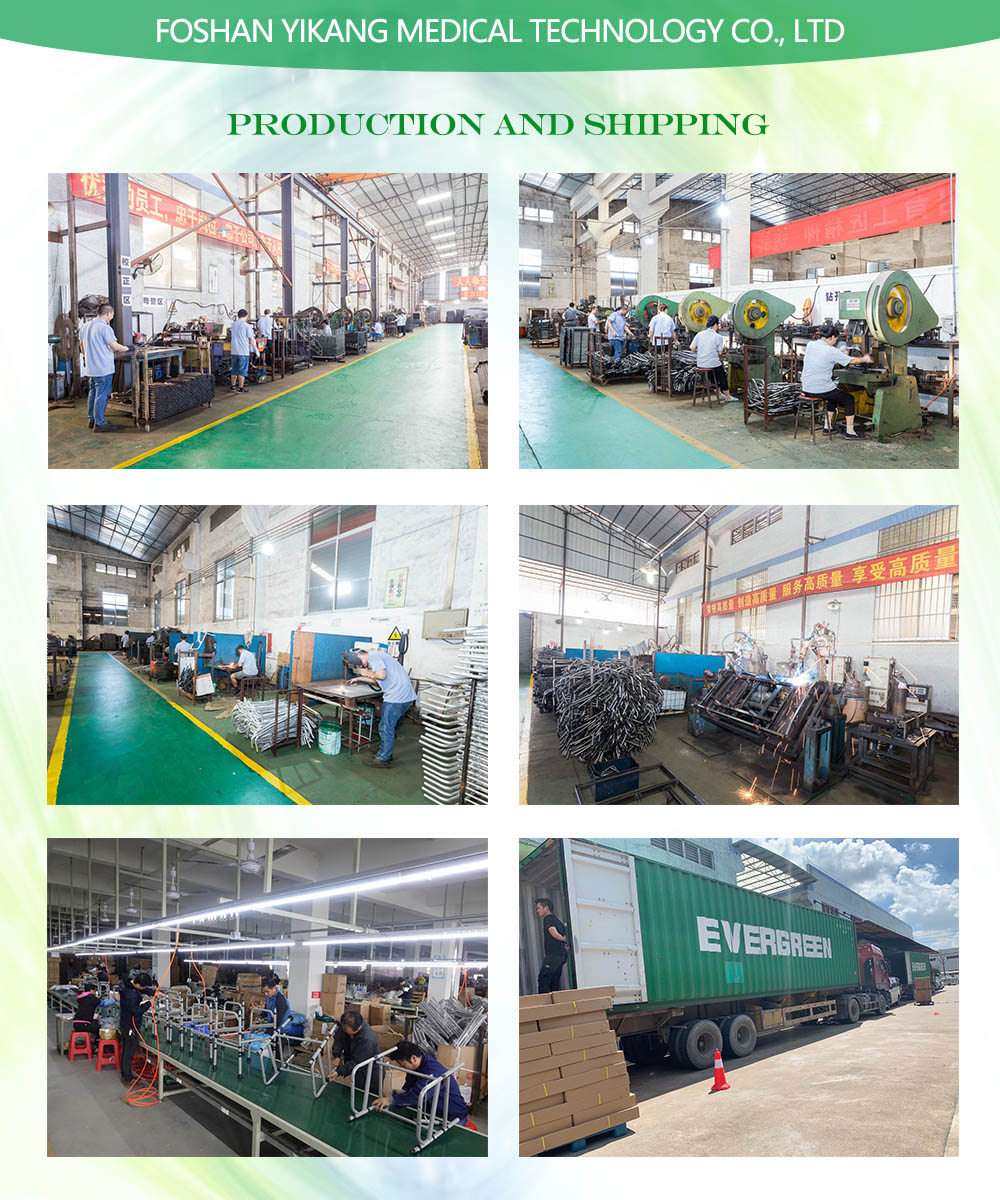
Yikang Medical has over a decade of experience in the medical equipment industry. Founded in 2010 in Foshan, China, we initially produced hardware and mechanical components. In 2014, we expanded to hospital beds and wheelchairs, becoming an OEM factory for top medical brands. Our product range now includes hospital beds, nursing beds, electric wheelchairs, manual wheelchairs, shower chairs, toilet chairs, walkers, and crutches.