

For many sports enthusiasts who are unable to participate in traditional standing fencing due to limited mobility, a common question arises: Is it possible to fence while seated in a wheelchair?
The answer is a resounding yes—and the fencing wheelchair has long been an essential piece of equipment in professional fencing.
Fencing is a sport that demands speed, reflexes, technique, and judgment. Regardless of whether one can stand, anyone with good upper-body strength, quick reactions, and an understanding of fencing techniques can participate in wheelchair fencing. Fencing wheelchairs are specifically designed to allow individuals with limited mobility to enjoy the competitive and technical aspects of the sport.
This article offers a professional analysis of how wheelchair fencing is conducted, covering the features, advantages, usage, rules, target audience, design logic, and safety aspects of fencing wheelchairs. It aims to provide a comprehensive understanding of why wheelchair fencing has become one of the most iconic sports for athletes with disabilities.
What is a fencing wheelchair, and how does it enable seated fencing?
A fencing wheelchair is a specialized, stationary sports wheelchair designed specifically for wheelchair fencing. Unlike standard wheelchairs or general sports wheelchairs, it is not intended for mobility; instead, it provides a stable, fixed, and adjustable platform that allows two competitors to execute fencing moves within a set range.
Fencing wheelchairs possess several defining characteristics:
1. The wheelchair is stationary and completely fixed in place
The core of fencing lies in hand and arm movements rather than footwork or locomotion. The fencing wheelchair is securely anchored to the floor or competition platform, allowing competitors to focus entirely on upper-body movements—such as thrusting, parrying, and counter-attacking.
2. The distance between competitors is adjustable
Since competitors have varying arm lengths, fencing wheelchairs allow for adjustments to the track or mounting fixtures to alter the distance between the two fencers, ensuring a fair match.
3. Seat angle and height meet the requirements of the fencing stance
Fencing wheelchairs feature specialized ergonomic designs:
•The seat height allows the fencer to maintain an optimal thrusting posture.
•The seat angle facilitates lateral swaying and flexible upper-body rotation.
•The rearward-tilted design enhances stability.
4. Sturdy structure capable of withstanding significant impact
Fencing is a combative sport; thrusting actions generate reactive forces, so the wheelchair must be structurally robust to ensure safety.
Through these specialized designs, fencing wheelchairs enable users—even those without lower-limb mobility—to execute standard fencing techniques.
Does using a wheelchair affect fencing technique?
Many people ask, "How can fencing be performed without moving one's feet?"
In reality, fencing is fundamentally an upper-body-driven sport. While traditional standing fencing relies on rapid footwork to advance and retreat, wheelchair fencing focuses entirely on:
•Arm speed
•Wrist technique
•Lines of attack
•Parrying methods
•Upper-body flexibility
•Reaction time
•Accuracy and rhythm
The footwork variations found in standing fencing are transformed in wheelchair fencing into:
•Upper-body leaning
•Rapid torso movement
•Leaning forward to thrust
•Leaning backward to defend
•Lateral body rotation
The stability and fixed angles of the fencing wheelchair provide the essential foundation for these movements.
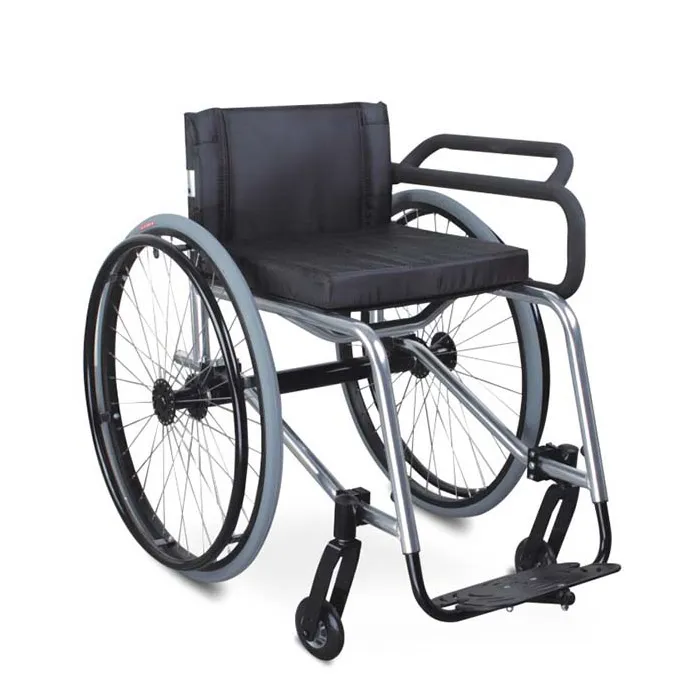
How does the fencing wheelchair design support high-speed combat?
To ensure that seated fencers experience a level of competitiveness comparable to standing fencers, the wheelchair design adheres to several core principles:
1. Anchoring mechanisms prevent the wheelchair from moving
During a match, any lateral movement would compromise fairness; therefore, the fencing wheelchair is secured to:
•Metal tracks on the floor
•Clamps on the competition platform
•A dual-wheel locking system
Fencers do not need to worry about the wheelchair shifting position, allowing them to execute offensive and defensive moves boldly.
2. The distance between wheelchairs can be adjusted according to the rules
The adjustment system on the fencing wheelchair allows for precise control of the combat distance between the two athletes, ensuring a fair contest regardless of differences in arm length.
3. Reinforced frame structure ensures safety during high-speed movements
Thrusting and parrying actions generate significant impact forces, so fencing wheelchairs utilize high-strength materials:
•Thickened aluminum alloy
•Steel fixing arms
•Reinforced welded structures
4. Agile rotation without tipping over
The lateral support design ensures the wheelchair remains stable when the athlete rotates rapidly or twists from side to side.
These structural features make the fencing wheelchair a piece of specialized sports equipment, rather than merely a modified standard wheelchair.
Why do the rules for wheelchair fencing differ from standing fencing?
To ensure fairness, wheelchair fencing incorporates unique rules, primarily centered on the core principle that the fencing wheelchairs remain stationary.
Here is the logic behind the key rules:
1. Stationary wheelchairs; changing position during the match is prohibited
Movement is restricted to the upper body.
2. A fixed distance must be maintained between the athletes' wheelchairs
The distance is measured by the referee based on arm length.
3. Attacks rely on the upper body rather than footwork
All offensive and defensive actions depend on:
•Arms
•Wrists
•Torso
•Body rotation
4. Significant body leaning is permitted
Actions such as leaning forward, leaning back, or twisting are allowed, provided they do not compromise the wheelchair's fixed position.
5. Target areas align with traditional fencing
For example:
•Foil: The upper body area covered by the metallic vest (lamé)
•Épée: The entire upper body
•Sabre: The area above the waist
Fencing wheelchairs ensure that seated fencing matches the competitive nature, technical complexity, and intensity of the standing sport.
What physical capabilities are required for wheelchair fencing?
Is complete lower-limb paralysis required to use a fencing wheelchair?
No.
The design of fencing wheelchairs accommodates a wide range of physical abilities.
Potential users include:
•Individuals with lower-limb mobility impairments
•Those who require assistive devices for walking
•Individuals with lower-limb instability
•Long-term wheelchair users
Users range from those with mild mobility limitations to those completely unable to stand.
Wheelchair fencing places greater emphasis on upper-body capabilities, including:
•Arm strength
•Wrist control
•Torso stability
•Reaction speed
•Technical understanding
Even if the lower limbs cannot participate in the activity, individuals with good upper-body function can engage in the sport using a fencing wheelchair.
What are the advantages of using a fencing wheelchair?
Fencing wheelchairs allow users to experience the sport while seated; key advantages include:
1. Emphasis on technique ensures a fair competition
Since the wheelchair is stationary, there is no disparity in movement speed; the competition focuses on:
•Reaction
•Technique
•Judgment
•Psychological strategy
2. High level of physical engagement and improved upper-body strength
Participants utilize numerous upper-body muscles during matches, helping to improve:
•Shoulder strength
•Arm strength
•Core strength
•Body coordination
3. Safety and control
The fixed structure ensures the wheelchair does not slide or tip over during competition.
4. Relatively low barrier to entry
It requires no running or jumping, making it suitable for individuals with various physical conditions.
5. A complete fencing experience
Allows for the execution of:
•Thrusts
•Parries
•Counter-attacks
•Offensive strategies
•Rhythm control
•Transitions between offense and defense
Fencing wheelchairs ensure that fencing is no longer a sport restricted to those who can stand.
What are the physical benefits of wheelchair fencing?
From a professional perspective, the specific physical benefits include:
1. Enhanced upper-body explosive power and endurance
Attacking, parrying, and rapid reactions all require arm strength.
2. Strengthened torso stability
Athletes continuously engage their core muscles to maintain balance while seated.
3. Improved hand-eye coordination
Fencing is fundamentally a sport that combines anticipation and reaction.
4. Enhances flexibility and body control
Rotational movements of the upper body (side-to-side) and forward-backward motions improve physical agility.
5. Helps improve concentration and judgment
Fencing is fast-paced and requires intense focus, offering benefits for both mental and cognitive training.
All of this demonstrates that wheelchair fencing is not only feasible but also highly effective for improving physical fitness.
Who is wheelchair fencing for?
Wheelchair fencing is suitable for:
•Individuals with lower-limb disabilities
•Those with limited mobility for outdoor activities
•Individuals who rely on walking aids
•People looking for an upper-body workout
•Those interested in skill-based sports
•People who enjoy competitive and strategic sports
Almost anyone with relatively normal upper-body function can participate.