

In recent years, as the profile of the Paralympic Games has risen, wheelchair tennis has increasingly entered the public consciousness. Many viewers often find themselves asking the same question: Is it really possible to play tennis while sitting in a wheelchair? Upon witnessing the high-speed movement, baseline rallies, and powerful serves characteristic of professional wheelchair tennis matches, that question naturally evolves into a more specific one: Can able-bodied people play wheelchair tennis?
On the surface, this might seem like a question that can be answered with a simple "yes" or "no." However, a true understanding of the sport and the technical systems behind specialized tennis wheelchairs reveals a far more complex reality. The crux of the matter is not merely whether one *can* sit in the chair and play, but rather: why able-bodied people *can* play, why many struggle to do so effectively, and why the technical proficiency of professional wheelchair tennis players often exceeds the expectations of recreational tennis enthusiasts.
In the public imagination, wheelchair sports are often mistakenly viewed as "watered-down" or "simplified" versions of traditional sports. Wheelchair tennis, however, is quite the opposite; it is not a diminished form of tennis, but a high-level competitive sport with its own distinct logic, technical framework, and equipment ecosystem. Its core piece of equipment—the tennis wheelchair—is not a standard everyday wheelchair but a highly engineered piece of sports equipment designed specifically for high-speed competition.
This article provides a comprehensive analysis of the sport—covering rules, design logic, the difficulty for able-bodied players, training value, and industry trends—while answering the central question posed in the title.
Wheelchair Tennis Is More Than Just "Playing Tennis While Seated"
When many people first hear about wheelchair tennis, the image that comes to mind is simple: an athlete sitting in a wheelchair, hitting a ball with a racket—and nothing more. This perception captures only the surface level, overlooking the true complexities of the sport.
Modern wheelchair tennis originated in 1976, driven by the efforts of American athlete Brad Parks. After suffering lower-limb paralysis due to a spinal cord injury, he began attempting to continue playing tennis from a wheelchair—an initiative that ultimately paved the way for the establishment of the competitive wheelchair tennis system. Today, wheelchair tennis is an official Paralympic sport and one of the fastest-growing sports for people with disabilities worldwide. According to data from the International Tennis Federation (ITF), wheelchair tennis programs are currently active in over 100 countries and regions, with more than 14,000 registered competitive athletes.
In terms of rules, wheelchair tennis bears a striking resemblance to standard tennis. Matches are played on courts of the same dimensions and with nets of the same height; standard tennis balls and rackets are used, and the scoring system is identical. This means that the standards of play have not been lowered to accommodate the athletes' physical conditions; the sport still adheres to the competitive framework of standard tennis.
The only significant difference in the rules centers on one key point: the ball is allowed to bounce twice. While standard tennis requires the ball to be returned after a single bounce, wheelchair tennis permits a return after two bounces on the player's side of the court—with the second bounce even allowed to occur outside the baseline. This rule was not introduced to make the game easier, but rather to compensate for the inherent physical limitations of wheelchair mobility. Even the most advanced tennis wheelchairs cannot fully replicate the lateral explosive power and ability to stop abruptly that come with running on two legs.
However, this does not mean wheelchair tennis is easier. On the contrary, it shifts the task of movement—normally handled by the legs—almost entirely onto the upper body and core.
Can able-bodied people play wheelchair tennis?
Yes, and there are no rules prohibiting it. Participation is not restricted to people with disabilities. In fact, many professional tennis players, coaches, and rehabilitation centers incorporate wheelchair tennis training for able-bodied individuals to improve spatial awareness, shot stability, and upper-body strength.
The challenge, however, lies in the vast gap between simply "being able to play" and "playing well."
Many recreational tennis enthusiasts experience a similar sense of frustration the first time they sit in a tennis wheelchair: despite being able to sustain long rallies with ease in their usual game, they find it difficult to even return the ball consistently once seated in the chair. This sense of frustration stems not from forgetting the stroke mechanics, but from the fact that the entire logic of movement has been completely rewritten.
In standard tennis, footwork is an often-overlooked, invisible foundation. Your ability to hit the ball comfortably relies on your legs constantly adjusting your position. Movements like split steps, side steps, crossovers, and explosive starts naturally bring your body to the optimal contact point. Most amateur players do not even realize that what they truly rely on is not their swing, but their footwork.
In wheelchair tennis, however, this system is entirely removed.
You cannot move using your legs; instead, you must rely on your hands to push the rims for starting, accelerating, decelerating, and turning, all while finding time to prepare your swing and strike the ball. In other words, tasks performed separately by the legs and hands in standard tennis are almost entirely concentrated in the upper body in wheelchair tennis.
This is why, even though an able-bodied person can sit in a tennis wheelchair, they usually find it difficult to adapt immediately.
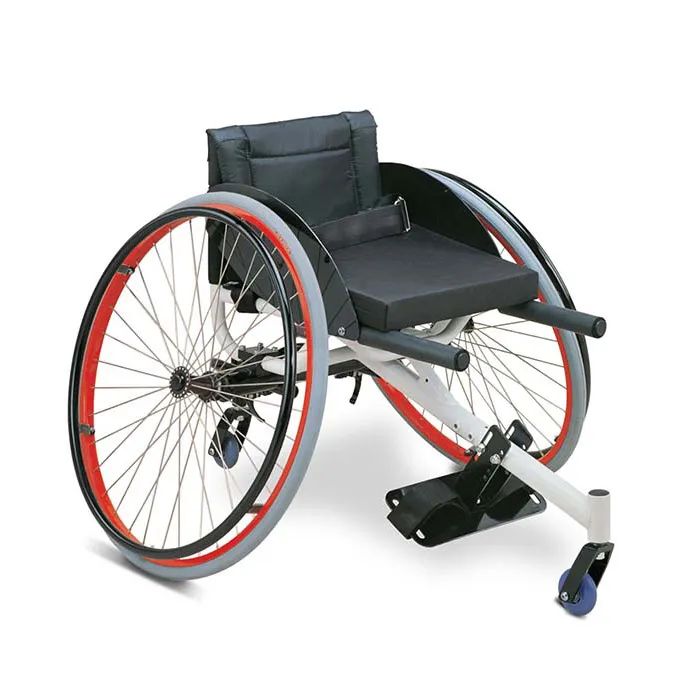
Why the tennis wheelchair is the core piece of equipment: it is essentially a competitive machine
To understand wheelchair tennis, one must first understand the tennis wheelchair itself.
Many people mistakenly believe that a tennis wheelchair is simply a standard wheelchair fitted with better tires. In reality, the differences between the two are so vast that they can hardly be classified as the same type of product. While standard wheelchairs are designed for comfort during daily mobility, tennis wheelchairs are engineered for competitive performance—prioritizing explosiveness, stability, maneuverability, and anti-tip capabilities.
The engineering design logic of tennis wheelchairs
The most distinctive feature is the camber angle of the large wheels on either side. On professional tennis wheelchairs, the large wheels are usually angled outward—a design known as "camber." Common angles range from 16° to 20°. This design significantly enhances lateral stability, preventing the chair from tipping over during high-speed turns, while also tightening the turning radius and improving overall maneuverability.
Secondly, tennis wheelchairs typically feature an additional anti-tip wheel at the rear. This is particularly crucial during the serve. The serving motion requires the athlete to lean back, raise their arms, and extend their core; without the support of an anti-tip wheel, the entire chair could easily tip over backward. Therefore, the anti-tip wheel is not merely an accessory, but a vital component for both safety and competitive performance. Furthermore, competitive-grade tennis wheelchairs are extremely sensitive to weight. Mainstream high-end models typically feature frames made of aluminum alloy, titanium alloy, or even carbon fiber, keeping the total weight between 8 and 15 kilograms. A reduction of just one kilogram can lead to perceptible changes in an athlete's propulsion efficiency and energy expenditure during a match. For professional players, a difference of a few hundred grams can alter the rhythm of an entire match.
Precisely for this reason, tennis wheelchairs come with a high price tag. On the global market, entry-level models usually cost between $3,000 and $5,000, mid-to-high-end models range from $5,000 to $9,000, and custom-made professional models often exceed $10,000. When converted to RMB, this means a high-performance tennis wheelchair can easily cost over 50,000 yuan, with top-tier configurations approaching 100,000 yuan.
Therefore, in terms of equipment, a tennis wheelchair is far more than a mere assistive device; it is akin to a professional race car in motorsports—it directly determines the upper limit of athletic performance.
Why is wheelchair tennis far more difficult than most people imagine?
The biggest misconception the general public holds about wheelchair tennis is underestimating the physical demands of the sport.
Many people instinctively assume that since the game is played while seated, it requires less physical exertion than running. In reality, the opposite is true; the energy expenditure in professional wheelchair tennis matches is often staggering.
First, movement and shot execution in wheelchair tennis share the same power system. In standard tennis, the legs handle movement while the arms handle the swing—tasks that are relatively distinct. In wheelchair tennis, however, the arms must simultaneously propel the wheels, execute the swing, and stabilize the torso. This places the shoulders, deltoids, triceps, latissimus dorsi, and forearm muscles under constant, heavy load.
Sports science research indicates that during high-intensity rallies, the upper-body power output of wheelchair tennis players can be 30% to 45% higher than during standard wheelchair movement. This load is not merely a case of "sore arms," but rather a deep-seated fatigue resulting from the continuous output of the entire upper-body kinetic chain.
Second, wheelchair tennis places extremely high demands on spatial anticipation. While able-bodied players can compensate for slightly poor positioning with their footwork, a wheelchair athlete who is even half a second late to start moving might completely miss the optimal hitting point. Consequently, wheelchair tennis relies heavily on anticipation; top athletes begin judging where the ball will land the moment their opponent starts their swing, initiating their wheelchair movement well in advance.
Finally, core stability directly impacts the ceiling of a player's technical ability. For many athletes with lower-limb impairments, core control is a primary training focus. They must maintain their balance while seated using their abdominal, lower back, and hip muscles, all while executing high-quality shots from an inherently unstable position. This means their shots are not merely technical maneuvers but a comprehensive demonstration of their physical control.
Just how skilled are professional wheelchair tennis players?
If you view wheelchair tennis merely as "inspirational sports," you are likely underestimating the sport's competitive intensity.
Top-level professional wheelchair tennis matches are incredibly fast-paced. Top male players can serve at speeds of 160 to 190 km/h, while top female players reach 120 to 160 km/h—speeds that would overwhelm the vast majority of amateur tennis enthusiasts.
Even more remarkable is their mobility. A professional wheelchair tennis player can cover a total distance of over 2 kilometers in a single match—all powered by their upper bodies. Every start, sudden stop, and turn involves intense physical exertion.
This means professional wheelchair tennis players possess not only exquisite technique but also exceptional cardiovascular endurance, explosive power, and neural reaction speeds. They are not simply "people persisting in sports despite adversity," but high-level competitive athletes in every sense of the word.
This is why many able-bodied people experience a major shift in perspective when they first sit in a tennis wheelchair: they expect it to be just another way of playing the game, only to discover they have entered an entirely different competitive system.
FAQ
Can able-bodied people participate in wheelchair tennis matches?
Amateur exhibition matches usually allow it, but professional Paralympic events generally require players to meet official disability classification standards.
Is there a big difference between a tennis wheelchair and a standard wheelchair?
A huge difference. Tennis wheelchairs are designed specifically for competition, prioritizing speed, stability, and maneuverability.
Are tennis wheelchairs expensive?
Entry-level models typically start at over 20,000 RMB, while professional-grade ones can reach 100,000 RMB or more.
Is wheelchair tennis easier than regular tennis?
It is not; in many respects, it is actually more difficult—particularly regarding movement and physical exertion.