

Are there foldable electric wheelchairs? Why are they generally lightweight and offer shorter driving ranges?
In recent years, driven by the accelerating global aging process and rising demand for rehabilitation and assistive devices, the electric wheelchair industry has been undergoing a significant product evolution. Market preferences are shifting from traditional, heavy-duty electric wheelchairs to the increasingly popular foldable models. Users are no longer satisfied with mere functionality; they now prioritize portability, travel-friendliness, ease of loading into vehicles, and efficient space utilization in their daily lives.
Consequently, a common question has emerged in consumer inquiries, dealer discussions, and industry forums: Are there foldable power wheelchairs? And if so, why are they typically lightweight yet often offer a shorter driving range compared to traditional models?
While these may seem like simple questions, the answers involve a complex balancing act within the industry—weighing mechanical structure, battery technology, materials engineering, and motor efficiency against real-world usage scenarios. Consumers often find the disparity puzzling: why might a traditional power wheelchair weigh 60 to 80 kilograms, while a foldable model weighs only 20 to 35 kilograms?
Even more confusing is the fact that reduced weight should theoretically imply greater efficiency; yet, many lightweight foldable models have a range of only 10 to 20 kilometers, whereas some large-scale electric wheelchairs can travel 30 kilometers or more.
To understand this issue, we must first look at the industry's core pain point.
Although traditional electric wheelchairs excel in power, range, and maneuverability, they suffer from a persistent, unresolved issue: a lack of portability. For many users, the primary frustration isn't the wheelchair's range, but the inability to easily take it out of the house. For instance, family members wishing to take an elderly relative to a medical checkup, a park, or the airport often find the wheelchair too heavy to lift into a car trunk; alternatively, for those living in older buildings without elevators, moving the wheelchair up and down stairs becomes a nearly impossible task. Industry research on assistive mobility devices reveals that for over 64% of households, the most common complaints following the purchase of their first electric wheelchair were not about insufficient battery range, but rather that the device was "too heavy," "difficult to move," or "took up too much space." Notably, around 41% of users cited the hassle of transitioning between indoor and outdoor environments as the primary reason for reducing their usage of the wheelchair.
This context lies at the heart of the rise of foldable electric wheelchairs.
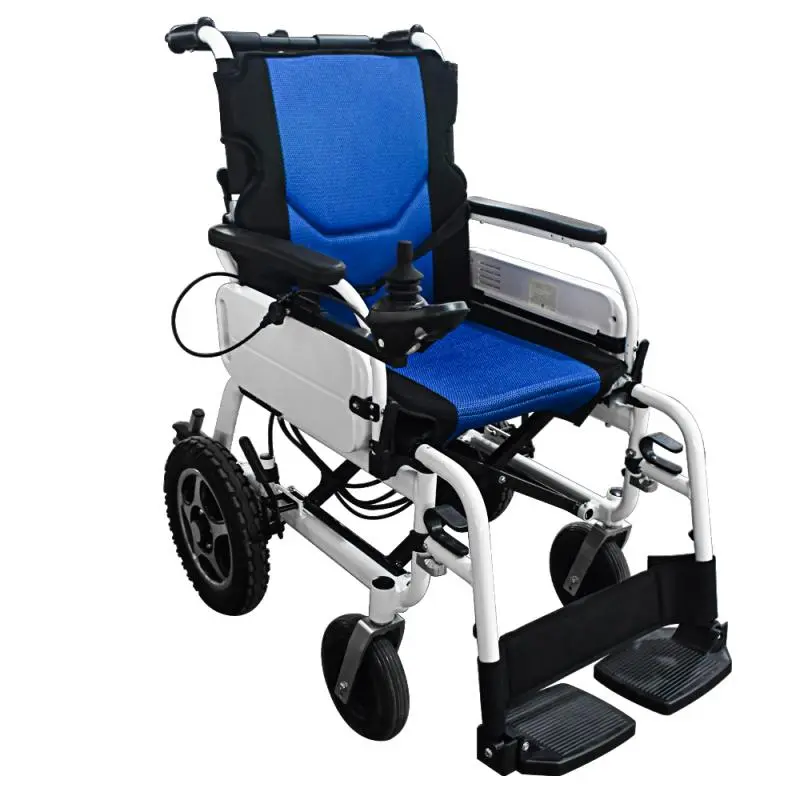
Do foldable electric wheelchairs exist?
Yes; not only do they exist, but they have also become one of the fastest-growing segments in the electric wheelchair market.
As the name implies, a foldable electric wheelchair utilizes mechanical hinges, a folding frame, quick-release mechanisms, or a modular design to allow for rapid folding when not in use. This significantly reduces the device's footprint, making storage, handling, and transport much easier. Compared to traditional rigid-frame models, foldable electric wheelchairs typically feature a more compact overall structure, lighter materials, a collapsible frame, and a detachable battery, prioritizing portability over maximizing battery range.
In terms of usage scenarios, foldable electric wheelchairs are particularly well-suited for several types of users: elderly individuals who frequently travel by car; rehabilitation patients who require assistance from caregivers to move the chair; users wishing to travel by air with their wheelchair; and households with limited living space. For these users, the value of a foldable electric wheelchair lies not merely in its ability to fold, but in how it significantly lowers the barriers to use.
Why are foldable power wheelchairs generally lighter in weight?
The reasons stem primarily from three factors: material lightweighting, structural simplification, and the miniaturization of the power system.
First is the shift in frame materials.
Traditional power wheelchairs rely heavily on steel structures. While steel offers high strength, low cost, and impact resistance, it has a significant drawback: heavy weight. Modern foldable power wheelchairs increasingly utilize materials such as aerospace-grade aluminum alloys, magnesium alloys, and even carbon fiber. To illustrate the difference in material density: standard steel has a density of approximately 7.85 g/cm³, whereas aluminum alloy is around 2.7 g/cm³—roughly one-third that of steel. This means that the frame weight can be significantly reduced while maintaining sufficient structural strength.
To take a simple example, a traditional steel power wheelchair frame might weigh over 20 kg, whereas using aerospace-grade aluminum alloy can bring that weight down to between 8 and 12 kg. The frame alone accounts for a weight reduction of 40% to 60%.
Secondly, the structural design is more compact.
Traditional electric wheelchairs often prioritize stability and heavy load-bearing capacity, resulting in wide chassis, large drive systems, and complex seat structures. In contrast, foldable electric wheelchairs must accommodate folding functionality, requiring designers to re-optimize the mechanical structure. Examples include the use of X-shaped folding mechanisms, central hinge designs, stowable armrests, and detachable footrests. This structural compactness reduces the total number of components and lowers the overall weight.
Thirdly, the power system itself is smaller.
Many foldable electric wheelchairs utilize small brushless motors. While traditional heavy-duty electric wheelchairs might use a single 300W or even 500W motor, lightweight models often employ dual 180W or dual 250W configurations. Although this shift reduces weight, it also directly impacts power reserves and driving range.
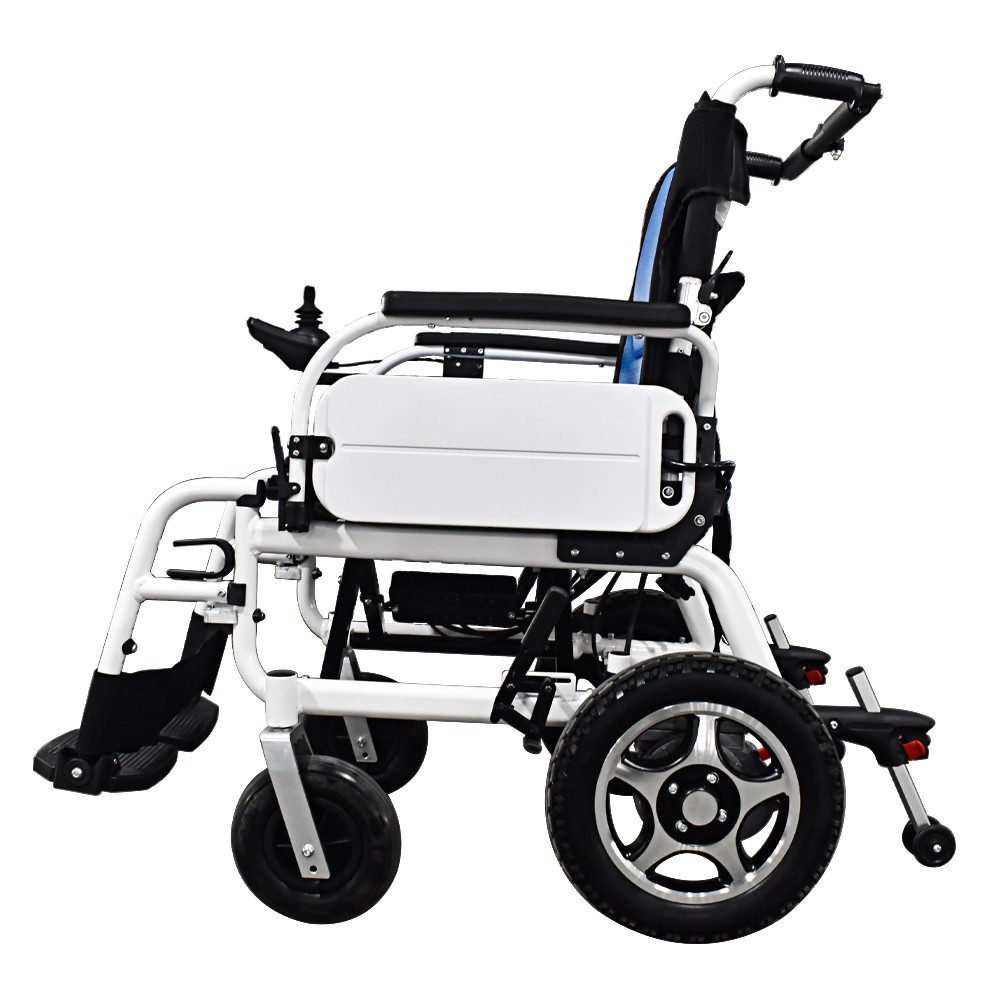
Why are foldable power wheelchairs lightweight but usually have a limited range?
Fundamentally, this is a classic engineering trade-off.
In electric wheelchair design, it is virtually impossible to maximize weight, range, power, and cost-efficiency simultaneously; improving one metric usually requires sacrificing another.
The most critical variable here is the battery.
An electric wheelchair's range depends primarily on the total battery energy, which is determined by the following formula: Battery Capacity (Wh) = Voltage (V) × Current Capacity (Ah)
For instance, a 24V 12Ah battery has a total energy of approximately 288Wh, whereas a 24V 20Ah battery reaches 480Wh. Theoretically, the latter naturally offers a longer range.
The issue, however, is that the greater the capacity, the heavier the battery. Take common lithium batteries as an example:
A 12Ah battery weighs approximately 2.5–3.5 kg;
A 20Ah battery can reach 5–7 kg;
Batteries exceeding 30Ah may approach 10 kg.
For traditional electric wheelchairs, adding a few extra kilograms has a limited impact because the vehicle is already heavy. However, for foldable electric wheelchairs, an extra 5 kg can completely compromise their portability.
This highlights a core conflict in the industry: users desire lightweight designs yet also want long range—but long range typically requires larger, heavier batteries.
Many consumers are unaware of this and often have unrealistic expectations: they want a foldable power wheelchair that weighs under 20 kg, offers a 40 km range, climbs hills, is air-travel compliant, and is affordable. From an engineering perspective, this is virtually impossible to achieve.
Air travel further exacerbates these constraints.
Many users of foldable power wheelchairs need to fly, yet there are strict regulations regarding lithium battery capacity for air transport. International aviation rules—and specific airline policies—often impose strict limits on battery energy capacity (measured in Watt-hours, or Wh), with common safety thresholds hovering around 300Wh. To ensure compliance with air travel regulations, many foldable power wheelchairs are forced to use smaller batteries.
This explains why the range of most mainstream foldable power wheelchairs on the market falls within the 10–20 km range.
Beyond battery capacity, tire size also affects range.
Traditional heavy-duty electric wheelchairs typically feature large drive wheels. Larger wheels offer lower rolling resistance and are more effective at overcoming obstacles. In contrast, foldable electric wheelchairs often use smaller wheels to minimize their folded size. While smaller wheels facilitate folding, they require more energy to maintain forward motion on rough terrain.
Additionally, factors such as seat width, load capacity, and controller efficiency influence range.
For instance, the range of the same foldable electric wheelchair can vary by more than 25% depending on whether the user weighs 60 kg or 100 kg. Actual range decreases further when navigating inclines, making frequent stops and starts, or facing headwinds.
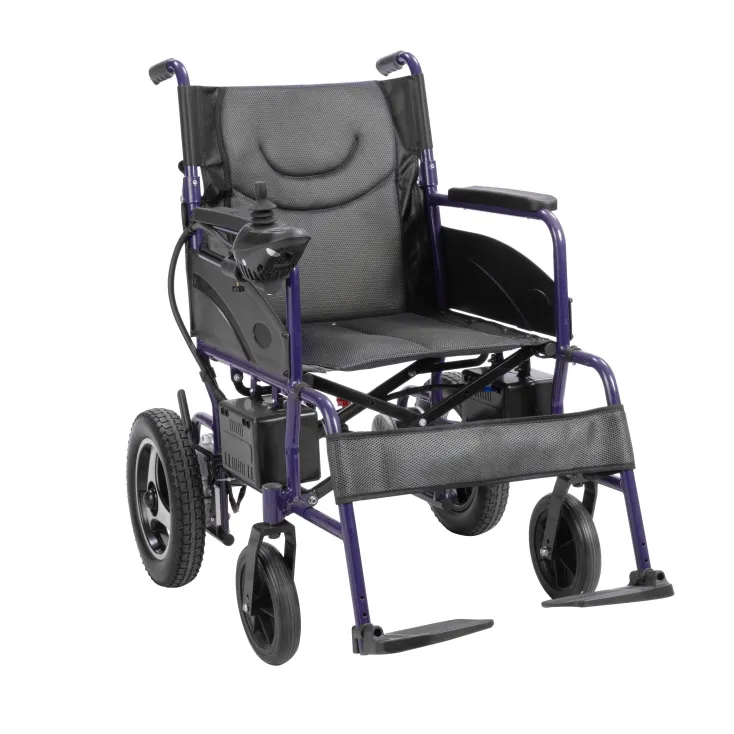
Does this mean foldable electric wheelchairs are unsuitable for long-distance use?
Not necessarily. It is all about matching the wheelchair to the specific usage scenario. If a user primarily needs the wheelchair for indoor mobility, neighborhood walks, hospital visits, or short-distance trips, a range of around 15 kilometers is usually sufficient. Statistics show that the average daily travel distance for most electric wheelchair users is actually less than 6 kilometers. In other words, many users do not require a range exceeding 30 kilometers; what they truly need is ease of storage and portability.
The industry is continuously developing solutions to address range limitations.
First is the application of high-energy-density battery cells. With advancements in lithium-ion technology, new technologies such as 21700 cells and solid-state batteries are increasing energy storage capacity per unit of weight. In the future, battery capacity could increase by 20% or more for the same weight.
Second is the detachable dual-battery configuration. An increasing number of foldable power wheelchairs feature modular designs that allow users to carry a spare battery. This approach avoids the issue of a single battery being excessively heavy while significantly extending the operating range.
Third is the optimization of motor efficiency. Combining brushless motors with Field-Oriented Control (FOC) algorithms reduces energy loss and improves output efficiency per watt-hour. Simply put, it allows the wheelchair to travel further on the same battery charge.
Fourth is the lightweighting of the entire vehicle. Reducing unnecessary weight inherently improves range; for every 1-kilogram reduction in total weight, energy consumption typically drops by 1% to 3%.
In this regard, companies that prioritize engineering design are beginning to establish a competitive edge through differentiation. Take Yikang Medical® as an example: our design philosophy for foldable power wheelchairs in the rehabilitation equipment sector does not merely chase maximum specifications; instead, it emphasizes a balance between being lightweight, reliable, and practical. For foldable power wheelchairs, what truly matters is not just the advertised range figure, but the vehicle's overall performance in real-world scenarios—factors such as folding efficiency, ease of transport, electronic control stability, ride comfort, and long-term maintenance costs.
This reflects the future direction of the industry. Users are becoming more rational; they no longer focus solely on a single figure from an advertisement but are more concerned with whether the device genuinely suits their lifestyle.
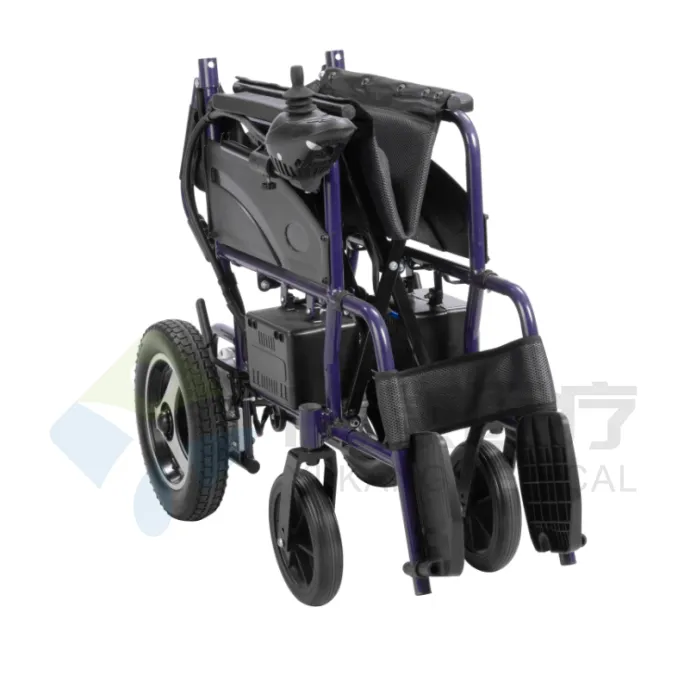
FAQ: Common Questions About Foldable Electric Wheelchairs
Q1: Do foldable electric wheelchairs actually exist?
Yes, and they are already very common. A large number of electric wheelchairs on the market support rapid folding.
Q2: How much do foldable electric wheelchairs typically weigh?
They generally weigh between 18 and 35 kg, depending on battery capacity, materials, and motor specifications.
Q3: Why do foldable electric wheelchairs usually have a shorter driving range?
It is primarily due to limited battery capacity; smaller batteries are often used to keep the weight down.
Q4: Are foldable power wheelchairs suitable for long-distance use?
It depends on the specific product. Most are better suited for short-distance, daily use—such as within residential communities, shopping malls, or hospitals.
Q5: How can the driving range of a foldable power wheelchair be extended?
Range can be improved by using a spare battery, regularly maintaining tire pressure, reducing the load, and optimizing driving habits.