
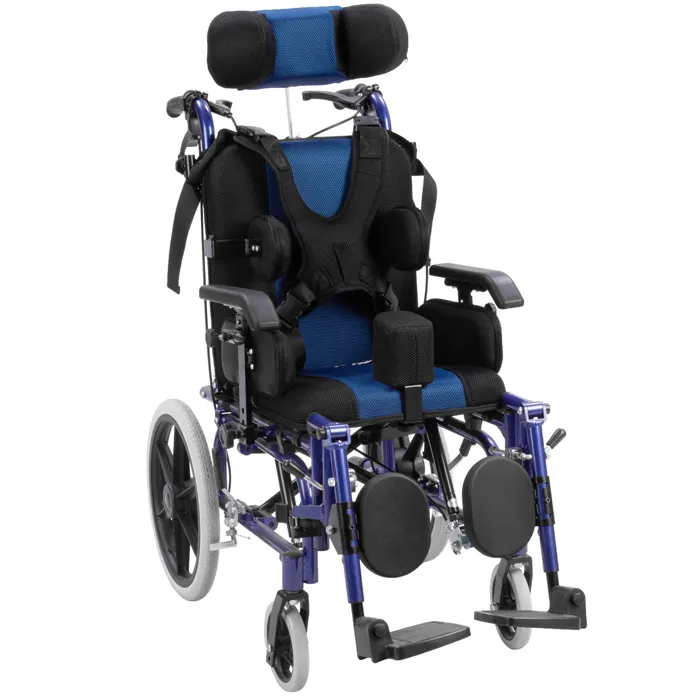
When choosing a wheelchair for a child with cerebral palsy (CP), safety is always one of the most important concerns for parents and caregivers. One frequently asked but often misunderstood question is: Do children's cerebral palsy wheelchairs have seat belts?
The answer is: The vast majority of children's cerebral palsy wheelchairs not only have seat belts, but they are often one of their core components. However, it's important to note that the "seat belt" on a children's cerebral palsy wheelchair is not the same as a seat belt on a regular wheelchair or other vehicle. They differ significantly in design purpose, structural form, and function.
This article will focus on the core question of whether children's cerebral palsy wheelchairs have seat belts, providing a systematic and professional explanation from the perspectives of structural principles, type classification, usage purpose, safety significance, and key points when purchasing, helping you fully understand the important role of seat belts in children's cerebral palsy wheelchairs.
Why must children's cerebral palsy wheelchairs be equipped with seat belts?
The biggest difference between a cerebral palsy wheelchair and a regular children's wheelchair or an adult manual wheelchair lies in the user's body control.
Most children with cerebral palsy exhibit one or more of the following:
• Weak trunk control
• Abnormal muscle tone (too high or too low)
• Prone to leaning forward, sideways, or backward
• Inability to maintain a stable sitting posture for extended periods
• Involuntary movements or sudden changes in posture
In these situations, without a safety harness or posture restraint system, the child's safety in the wheelchair cannot be guaranteed. Therefore, a safety harness is not an "additional feature" of a cerebral palsy wheelchair, but rather a basic feature.
The main functions of a safety harness include:
• Stabilizing body posture
• Preventing slippage or forward leaning
• Assisting in trunk and pelvic alignment
• Reducing the risk of falls
• Improving overall sitting posture safety
For this reason, safety harnesses are integrated into the overall posture control system during the design phase of a cerebral palsy wheelchair.
What are the differences between the seat belts on a child cerebral palsy wheelchair and those on a regular wheelchair?
This is a point of confusion for many parents.
Characteristics of a regular wheelchair seat belt:
• Usually a single lap belt
• Primarily prevents the user from sliding forward
• Limited adjustment range
• Not designed for long-term posture management
Characteristics of a child cerebral palsy wheelchair seat belt:
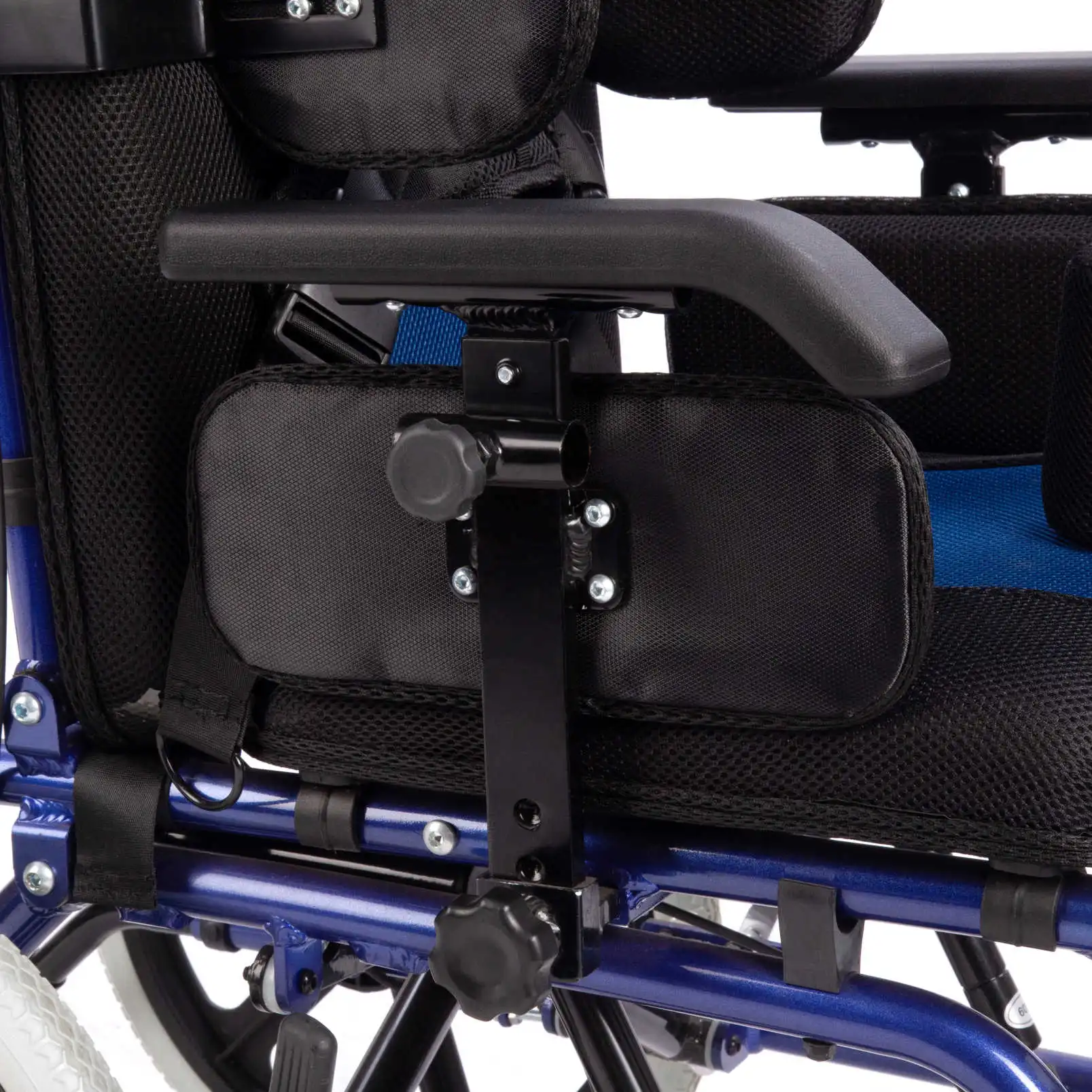
• Usually a multi-point structure
• Linked with the seat, backrest, and pelvic support system
• Can be finely adjusted according to the child's body size
• The goal is postural stability + safety protection
In other words, the seat belt on a child cerebral palsy wheelchair is essentially a "posture control belt" or "fixation system," not just a fall prevention device.
What types of seat belts are typically equipped on a child cerebral palsy wheelchair?
Different models and functional levels of child cerebral palsy wheelchairs will have different seat belt types. The following is a systematic introduction to common types.
Does a child cerebral palsy wheelchair always have a pelvic safety belt?
The answer is: almost certainly yes, and it's crucial.
A pelvic harness is the most basic and important type of harness in a child's cerebral palsy wheelchair.
Its main functions include:
• Securing pelvic position
• Preventing pelvic slippage or posterior tilt
• Helping maintain correct posture
• Providing a foundation for trunk stability
Common types of pelvic harnesses include:
• Two-point pelvic harness
• Four-point pelvic harness
• Adjustable positioning pelvic harness
In a child's cerebral palsy wheelchair, the absence of a pelvic harness almost guarantees ineffective postural control, making it an indispensable feature.
Do child cerebral palsy wheelchairs come with a chest harness?
In wheelchairs used by children with moderate to severe cerebral palsy, the answer is yes.
Chest harnesses are primarily used to:
• Stabilize the upper body
• Prevent forward or side tilting of the torso
• Assist head and neck control
• Improve overall posture symmetry
Common chest harness types include:
• X-shaped chest harness
• H-shaped chest harness
• Y-shaped chest harness
These harnesses are not intended to "restrain" the child, but rather to provide necessary external support when the child cannot actively control their torso.
In many cerebral palsy wheelchairs, the chest harness works in conjunction with the lateral support and backrest system.
Do cerebral palsy wheelchairs use multi-point harnesses?
For children with high postural control needs, the answer is yes.
Multi-point harness systems typically include:
• Pelvic belt
• Chest belt
• Shoulder restraint belt
• Sometimes combined with leg anchors
These harnesses work together to achieve:
• Overall postural stability
• Prevention of involuntary body movement
• Reduction of pressure concentration caused by poor posture
Multi-point harness systems are commonly found in high-functioning cerebral palsy wheelchairs or rehabilitation wheelchairs.
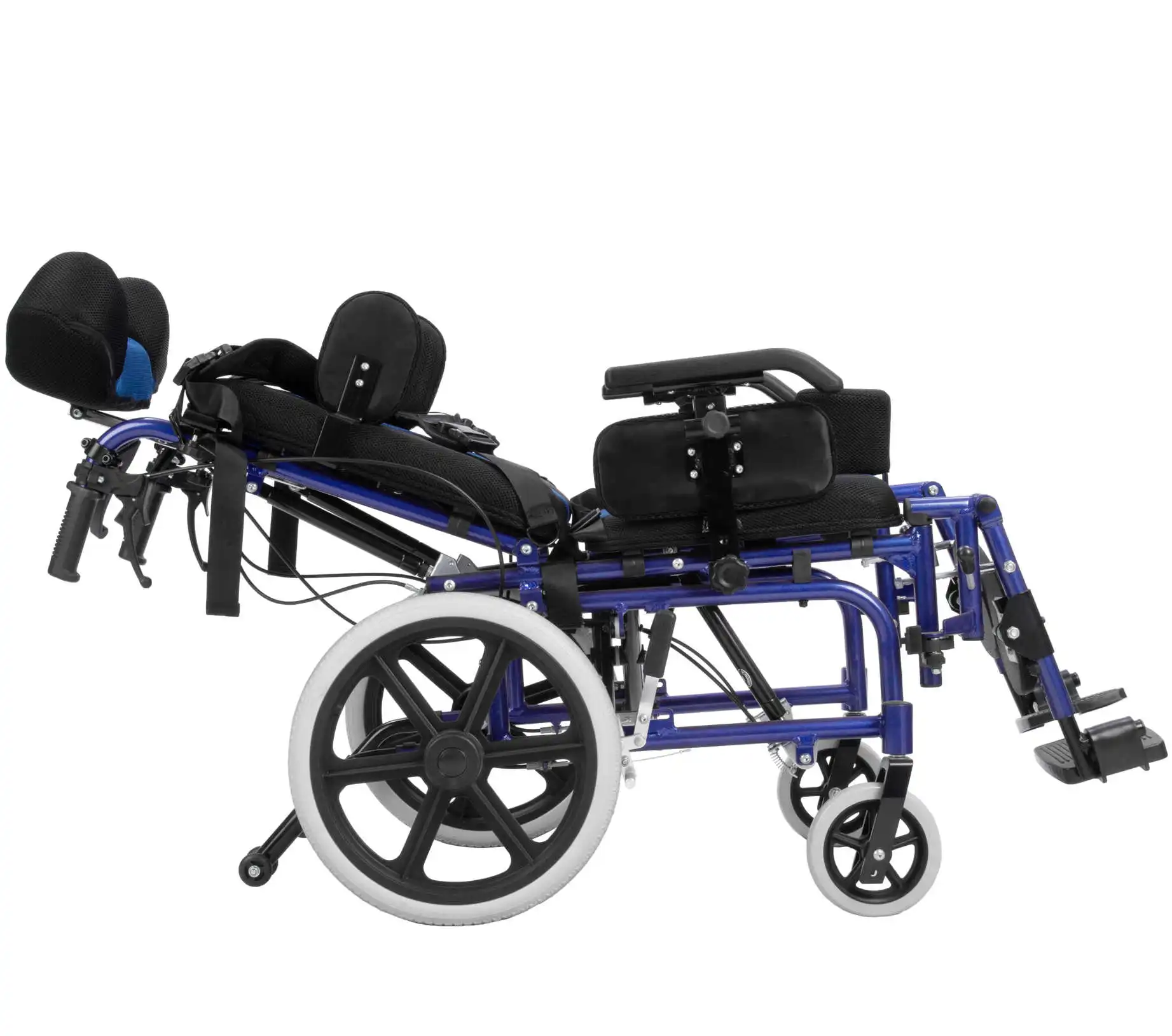
What safety issues do harnesses primarily address in cerebral palsy wheelchairs for children?
Harnesses do more than just "tie the child down"; they address a range of practical problems.
1. Preventing forward slippage
Many children with cerebral palsy are prone to slowly slipping forward while sitting due to low muscle tone or insufficient control.
2. Reducing lateral tilt and rotation
Lateral instability is a common problem in children with cerebral palsy; harnesses combined with side braces can effectively control this.
3. Improving sitting posture symmetry
Adjusting the harness helps maintain balance between the left and right sides of the body.
4. Reduces the risk of falls
Especially when moving, turning, or going uphill/downhill in a wheelchair.
5. Enhances safety and comfort
A stable posture allows children to relax more and facilitates eating, communicating, and activities.
Will the seatbelt on a child cerebral palsy wheelchair affect comfort?
This is a common concern among parents.
In fact, a well-designed and correctly used seatbelt will not only not reduce comfort, but will actually improve it.
Reasons include:
• Reduced muscle tension after posture stability
• More even pressure distribution
• Less need for frequent posture adjustments
• Reduced physical fatigue
Provided that:
• The seatbelt width is appropriate
• The material is soft yet supportive
• The adjustment method is correct
• It does not constrict, compress, or restrict breathing
High-quality child cerebral palsy wheelchairs consider both comfort and safety when designing their seatbelts.
How should you pay attention to the seatbelt configuration when choosing a child cerebral palsy wheelchair?
When choosing a child cerebral palsy wheelchair, the seatbelt configuration is a crucial evaluation point.
Key aspects to consider include:
1. Whether a pelvic seatbelt is standard.
2. Whether it supports chest or multi-point harnesses.
3. Whether the seatbelt's length and angle are adjustable.
4. Whether it can be adjusted according to the child's growth.
5. Whether it is easy to remove and clean.
6. Whether the seatbelt is compatible with the seat system.
If a child cerebral palsy wheelchair only comes with a simple lap belt without a systematic posture restraint design, its suitability needs careful evaluation.
Is the seatbelt in a child cerebral palsy wheelchair considered a "restraint" device?
This is a question easily misunderstood.
From a professional perspective, the seatbelt in a child cerebral palsy wheelchair is not a restraint tool, but rather a posture support and safety protection device.
Its design goals are:
• Assist in maintaining functional posture
• Reduce risk
• Increase participation
• Enhance safety
When used correctly and adjusted properly, a seatbelt will not restrict a child's normal activities; on the contrary, it provides necessary support.
Do children with different degrees of cerebral palsy have different seatbelt needs?
The answer is yes.
Children with mild cerebral palsy:
• May only need a pelvic seatbelt
• To prevent slipping
Children with moderate cerebral palsy:
• Usually need a pelvic belt + chest belt
• Provide trunk stability
Children with severe cerebral palsy:
• Often need a multi-point harness system
• Used in conjunction with headrests and side braces
Therefore, seatbelt configuration must be matched to the child's functional level, rather than "one seatbelt for everyone."
Can a child's cerebral palsy wheelchair be used without a seatbelt?
From a professional perspective, this is not recommended for most children with cerebral palsy.
The lack of a seatbelt can lead to:
• Unstable sitting posture
• Increased risk of slipping
• Worsening posture
• Increased safety hazards
Therefore, a seatbelt is a crucial component for ensuring safety and posture when using a child's cerebral palsy wheelchair.
What hospital beds does Yikang Medical manufacture?
Yikang Medical, based in Foshan, China, is a professional manufacturer and supplier of hospital beds for healthcare facilities worldwide. Since 2010, we started producing high-quality mechanical parts and hardware, expanding to hospital and nursing beds in 2014. Our products are sold globally and trusted by major brands through OEM partnerships.
We offer customization for hospital bed size, features, color, and configuration to meet client requirements. With ISO13485, ISO9001, CE, and FDA certifications, Yikang Medical ensures safety, durability, and reliable delivery.