
Real issue in the industry: It is common that many people only know "you should wear a seat belt," but they do not know "the reason why" and "the proper way how" to wear it.
Though the wheelchairs for cerebral palsy children market is continuously growing, one of the most common issues is still found in practice: parents, caregivers, and even some unskilled sales assistants consider "seat belt" only as a standard accessory, instead of a functional part that must be fine-tuned to the child's physical condition.
For instance, a parent may, when the child is sitting in a wheelchair for children with cerebral palsy, and the pelvis keeps moving forward, subconsciously pull the lap belt tighter, hoping thereby to hold the child back by creating a stronger pulling force. Still, if the lap belt is placed way above that pelvic region, having shifted into the lower abdominal area, not only will it fail to tackle the actual issue on the pelvis positioning but could also cause discomfort or worse create new safety hazards. The NHS wheelchair safety database states the accurate posture/seat belt is one that applies a right angle of pressure on the pelvic area; that the belt being too high and thus placed in the lower abdominal soft tissue region would probably not be able to prevent a downward sliding of the entire body.
Confusion between "posture belts" and "car seat belts" is another problem. The pelvis belt of wheeled chair for cerebral palsy children helps the child in keeping the sitting posture, whereas the passenger restraints in cars are made to handle deceleration and impact forces from collisions. According to the AAP, the child's traffic safety is of paramount importance and that devices for sitting position support of regular wheelchairs in general have never been tested to be crashproof, thus, they cannot simply be replaced or used in place of seat belths based on their looks.
So, to grasp what role a chair "seat belt" performs on a wheelchair for children with cerebral palsy, the first thing should not be to research the belt width or buckle's substance, but to figure out if it is either a posture positioning device, or, an occupant restraint system with valid transportation certification that has been exclusively designed and manufactured for the purpose of transportation.
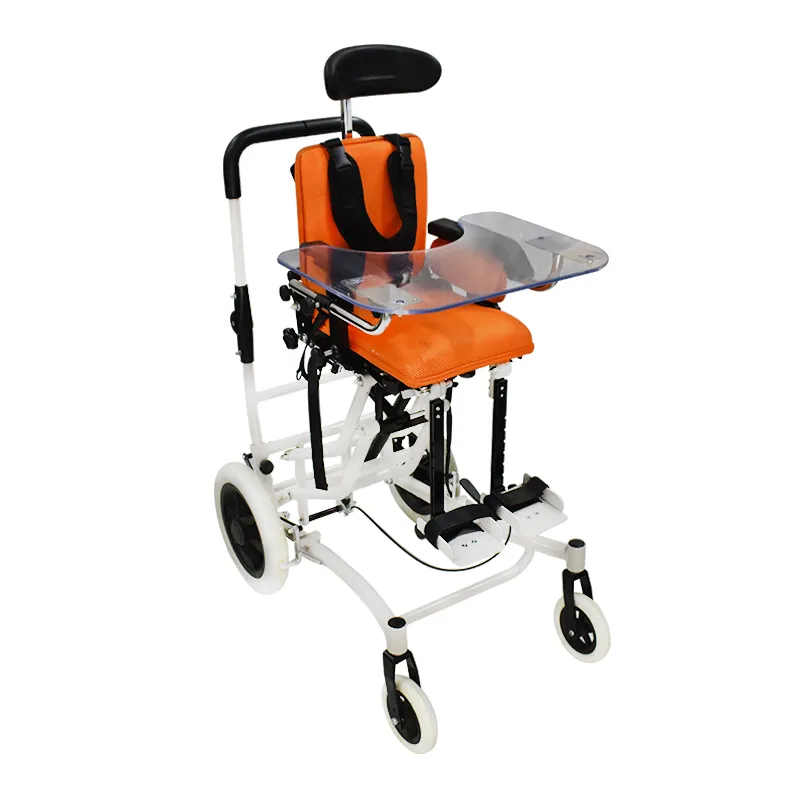
What makes seat belts so simple to use on the wheelchairs of children with cerebral palsy?
To comprehend the reasons behind using safety seat belts, one needs to look at the specific challenges presented by the sitting posture issues of children with cerebral palsy:
Firstly, it must be made clear that cerebral palsy represents a category of neurological development disorders that impact motor and postural control. Also, the motor skills of different individuals vary a lot. Some of the affected children are capable of getting up and sitting without assistance, yet, their balance while sitting is quite weak; some may have serious deviations in the level of muscle tone; a few can be quite weak in controlling the body core, pelvic asymmetry, difficulties to fix feet, or a bias of inclination to either side.
A typically developing child's body sitting in and moving around on a regular chair is a subtle and continuous adjustment process. For example, when they are shifting a bit forward, they can contract their trunk muscles to push themselves back sitting. When the lean to sides (e.g., turning right) happens, they usually use their arms or trunk to adjust their position back.
On the other hand, some children with cerebral palsies do not have such a facility for active movement.
Sitting is something that most persons do effortlessly without any thought about it. However, for children suffering from cerebral palsy this is totally different. It is almost impossible to get and maintain their sitting position. This is very crucial because any shift in the child's posture or position has a knock-on effect on the child's development. Any such change in the child's seat position will definitely result in a change of head position, eyes, feeding, communication, upper limbs, and even breathing.
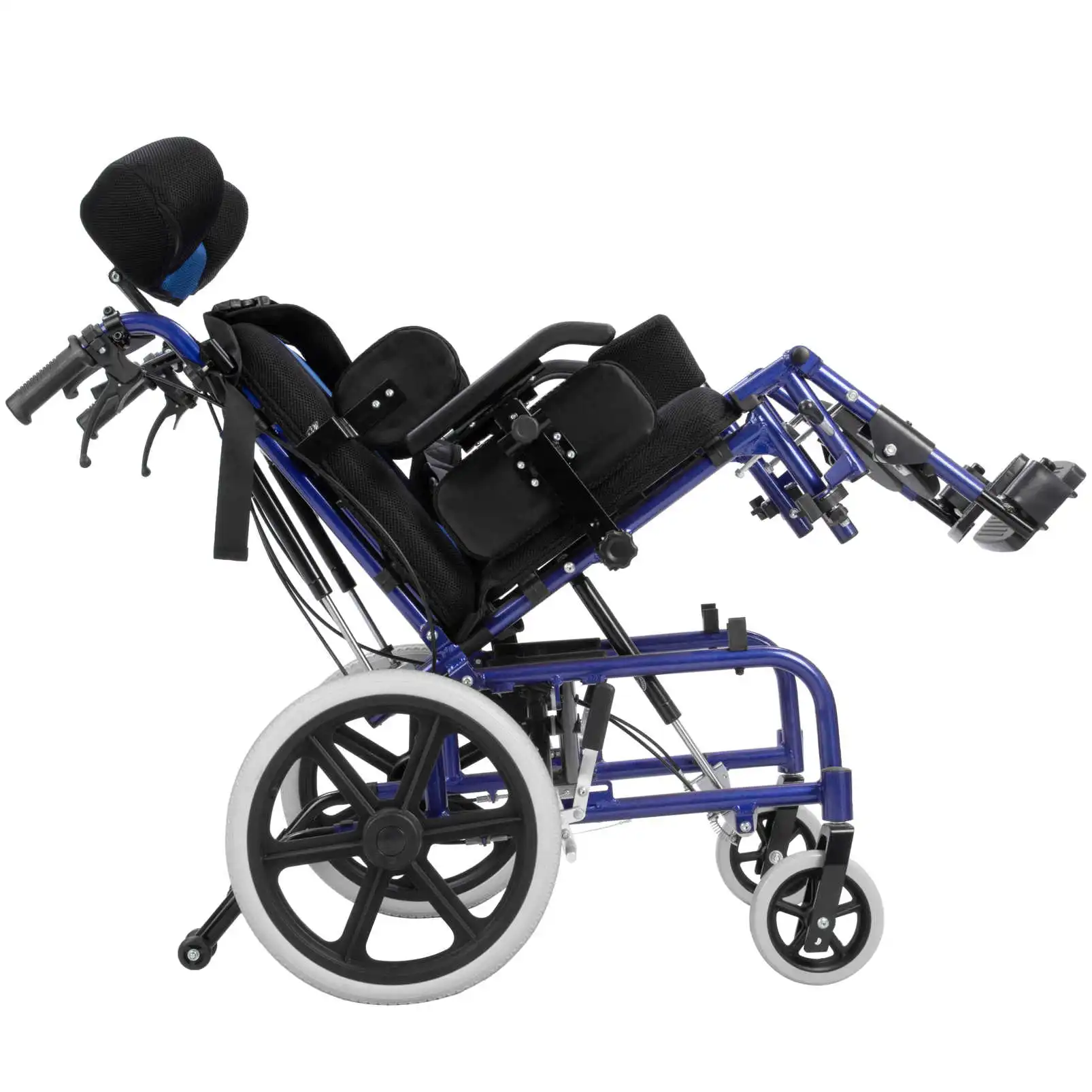
With that, the wheelchair designer can easily figure out that one of the main objectives of designing a wheelchair that's suitable for children with cerebral palsy is through the use of seat, backrest, waist, leg, head, and foot support components, the body is brought into a stable position, allowing the child to carry out his/her daily activities.
The American Academy of Pediatrics has also published the "Practice Parameter: Care of Children with Cerebral Palsy" that lists the following as the top assistive technology: wheeler, seating system, standing devices, which they have been identified as the top assistive technologies for supporting the body alignment, joint stability, and participation in daily living activity,
For wheelchairs made especially for children who have Cerebral Palsy, the safety harneses are designed not to "limit the children's movement" but may help in forming the whole posture management system as an "integral" part.
One of the most important components: What is the function of the pelvic belt?
One of the most common types of safety belts in wheelchairs for children with cerebral palsy is the pelvic belt, also known as a lumbar belt, hip belt, or pelvic belt.
Functionally, the core task of the pelvic belt is usually to help keep the pelvis within the target area of the seat design.
The process of a child sitting in a wheelchair for children with cerebral palsy can be imagined as a system that establishes stability from the bottom up: first, the pelvis needs to be in the correct position; then, the backrest and lateral support help stabilize the trunk; then, the headrest and other supports control the upper body posture; and finally, the footrest and leg support establish lower limb stability.
If the position of the pelvis at the bottom keeps changing, all the upper supports may lose their optimal function.
Therefore, pelvic belts are not simply for "stabilizing the lower back," but rather to help prevent the pelvis from shifting forward and the body from gradually sliding out of the seat.
UK healthcare system wheelchair posture guidelines recommend that when using a pelvic belt, the user should first sit as far back as possible in the seat, positioning the pelvis appropriately, and then the belt should be adjusted to provide stable support in the pelvic area. Some clinical guidelines also use the ability to "insert about two fingers" as a visual check to avoid excessive tightness, but the actual tightness should still be determined based on the specific equipment, the child's size, and a professional assessment.
Here is a crucial concept: a seatbelt is not necessarily safer the tighter it is.
If the pelvic belt on a child's cerebral palsy wheelchair is too loose, it may not achieve the desired posture retention; if it is too tight, it may cause pressure and discomfort. The ideal balance is to maintain pelvic positioning without hindering breathing, swallowing, abdominal movement, and normal bodily functions.
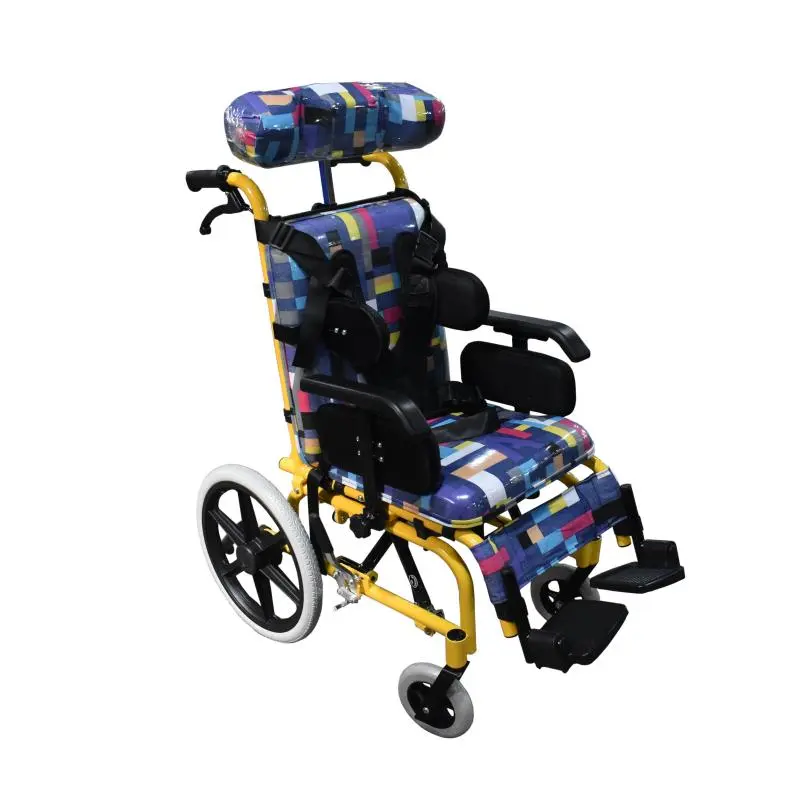
Why do some wheelchairs for children with cerebral palsy also include a chest strap?
For some children, simply stabilizing the pelvis is not enough.
If a child exhibits significant trunk control deficiencies, even if the pelvis remains above the seat, the upper body may still tilt forward, sideways, or backward.
In such cases, wheelchairs for children with cerebral palsy may be equipped with chest support belts, thoracic supports, or other trunk positioning components.
However, chest belts and pelvic belts serve different purposes.
Pelvic belts primarily address pelvic positioning, while chest supports help maintain the trunk in a relatively stable position. If designed properly, both can provide coordinated upper and lower body postural support.
However, it's not simply a matter of "more pelvic belts and chest belts equals greater safety." Children require a certain degree of active movement space. The goal of assistive devices should be to provide sufficient stability while preserving as much of the child's voluntary movement as possible.
This is also one of the key differences between wheelchairs for children with cerebral palsy and ordinary adult care wheelchairs: children are still in a stage of growth and development, and wheelchairs must not only address the current sitting posture but also consider long-term use, changes in body size, and functional training.
Why are seat belts on wheelchairs for children with cerebral palsy usually installed near the pelvis?
Because the pelvis is a crucial foundation for stable sitting posture.
If the seatbelt is positioned above the abdomen, it may not effectively control the pelvis when the child slides forward. Conversely, if the seatbelt is designed to operate in the pelvic area, it will more easily help maintain pelvic position.
NHS wheelchair safety guidelines clearly state that the correct seatbelt position should be in the pelvic area and at the appropriate angle. If the seatbelt is positioned in the soft tissue area of the lower abdomen above the pelvis, it may not effectively prevent further forward sliding.
Therefore, in the actual use of wheelchairs for children with cerebral palsy, parents should not only observe whether the seatbelt is fastened, but also where it is fastened.
This is the first step in determining whether the seatbelt of a wheelchair for children with cerebral palsy is being used correctly.
If, after the child sits in the wheelchair, the pelvis moves significantly forward and the body gradually assumes a "sliding" posture, even if the seatbelt is fastened very tightly, it does not mean that the positioning is correct.
Why do wheelchairs for children with cerebral palsy need to be used with a seat cushion?
Many people believe that the seatbelt is responsible for stabilizing the body, and the seat cushion is only for the child's comfort.
In fact, the seat cushion in a professional wheelchair for children with cerebral palsy is much more than just a "soft cushion."
A wheelchair seat cushion for children with cerebral palsy may serve functions such as pressure distribution, pelvic positioning, ischial support, and posture assistance.
Pressure management is crucial for children who use wheelchairs long-term. The American Academy of Pediatrics points out that some children with cerebral palsy are at risk of pressure injuries, especially those with reduced mobility, inability to change position independently, sensory abnormalities, or a history of pressure injury. Related preventative measures include frequent position adjustments, using appropriate wheelchair seat cushions, and providing protection for bony prominences.
Therefore, a complete posture system for a wheelchair for children with cerebral palsy should generally be considered holistically, including seat cushion + pelvic belt + backrest + lateral support + foot support.
Adding only a safety belt without addressing issues of seat depth, seat width, pelvic position, and foot support may only temporarily mask the posture problem without addressing the root cause.
Why do wheelchairs for children with cerebral palsy also need footrests and leg support?
Many parents focus on the safety belt but easily overlook foot support.
In fact, stable foot placement is very important for overall posture.
If a child's feet are dangling, the weight of their legs can pull on the pelvis; if their legs are spread outwards or constantly sliding to one side, pelvic stability may also be affected.
Therefore, wheelchairs for children with cerebral palsy usually require adjustments to the footrest height and position based on the child's height, lower limb length, and postural needs.
For some children, ankle braces, leg rests, or other lower limb positioning components may also be needed.
However, it is important to emphasize that more of these components are not necessarily better. Wheelchairs for children with cerebral palsy should prioritize functional positioning, rather than simply aiming to "immobilize the child completely."
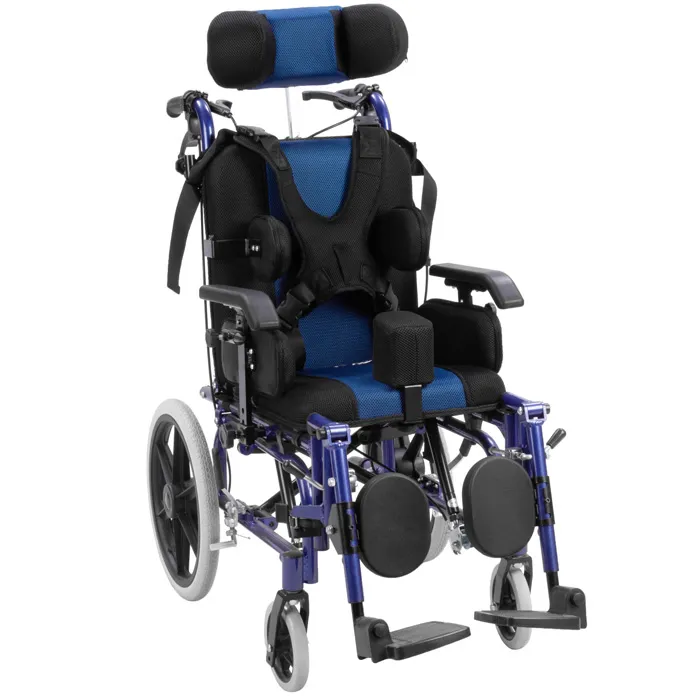
What is the difference between seat belts in wheelchairs for children with cerebral palsy and car seat belts?
This is a crucial point to clarify.
Wheelchair posture harnesses and car seat belts should not be confused.
The pelvic belt, chest strap, and posture harness in ordinary wheelchairs for children with cerebral palsy are primarily for seating positioning and are generally not designed for motor vehicle collision scenarios.
Car seat belts, on the other hand, are part of the vehicle's occupant restraint system and need to consider the high-speed deceleration and massive impact loads during a collision.
The American Academy of Pediatrics (AAP) transportation recommendations for children with special health needs state that if a child must travel in a wheelchair, a specially designed wheelchair restraint and occupant restraint system should be used. For children in wheelchairs, both the wheelchair's own restraint and the child's body restraint must be considered separately. AAP materials also specifically point out that posture support devices on ordinary wheelchairs are usually not crash-tested and therefore cannot replace a vehicle's occupant restraint system.
Therefore, if a child with cerebral palsy needs a wheelchair for vehicle transportation, parents should not assume that "the wheelchair already has a seatbelt, so the child can just sit in it and get in the car."
The correct transportation plan requires a professional assessment based on whether the wheelchair is appropriately designed for transportation, the type of vehicle, and the child's individual circumstances.
Why do some wheelchairs for children with cerebral palsy use a five-point harness?
The five-point harness is common because it provides multi-directional positioning of the trunk and pelvis.
However, "five-point" itself does not necessarily mean safer.
Whether a five-point harness is necessary requires an assessment considering the child's trunk control ability, muscle tone, activity patterns, pelvic stability, and the specific seating system.
For some children, a simple pelvic belt is sufficient; for others with significant trunk instability, additional chest or shoulder support may be necessary.
More complex restraint systems typically mean more complex adjustment requirements.
If parents, without professional guidance, simply judge the "more straps, the better" mentality based on product photos, they are more likely to end up with inappropriate restraints.
Therefore, the design of safety belts for wheelchairs for children with cerebral palsy should follow the principle of "configuration based on functional needs," rather than "judging safety based on visual complexity."
What is the recommended way to adjust the safety belts in a wheelchair for a child with cerebral palsy?
Child should be positioned in the wheelchair with the greatest part of their back supported by the seat back, their buttocks touching the seat edge and their pelvis aligned within the seat support area.
Then look to see if the child keeps the pelvis stable. A large amount of movement forward of the child or the pelvis rotating, if they're doing those movements, would be an indication that seat depth, backrest height, and footrests need to be evaluated for the child before securing the waist harness.
Get the waist belt down to about the pelvic area of the wheelchair.
Fasten the waist belt but still leave room for one hand between the belt and the child's belly.
Besides, watch the child closely, checking their overall condition, for example, breathing, swallowing, head, chest, back posture, legs position, and skin condition.
A British guideline of a medical centre says that a correct posture is an essential requirement when fastening a waist harness and it is advisable to regularly inspect skin state, position, and tightness; some other resources even mention that when under appropriate conditions, about two fingers should be able to be placed under the waistband in order not to tightness to the extreme.
"Finger test," however, should be considered a supporting method only and not as a definitive criterion for the child's safety belt suitability; therefore, the final decision should always be left with the occupational therapist or a seating specialist who are able to carry out individual assessment.
When is it a good time to reposition the waist harness of a child's cerebral palsy wheelchair?
When the harness fails to hold the child back it is a sign of improper use and you should change the harness.
If the child is sitting on one side more than the other it would indicate that their seating system requires readjustment.
A shift of a safety belt to the abdomen is one example of how to check if the position of the attachment point or the user's sitting position needs to be changed.
Skin issues such as red marks, pressure indentations and pain which are signs of pressure ulcer development call for a check-up right away.
If the height, weight and proportion of the child's body have changed a lot from earlier measurements it is definitely a good idea to do a reassessment.
Because children develop rapidly, the setting of a cerebral palsy-child's wheelchair cannot just be done once for all.
For instance, the seat width and depth, the backrest height, the footrest height and the pelvic girdle position will have to be rechecked for the growing child.
This is one of the major reasons that the difference between a cerebral palsy child's wheelchair and a regular adult wheelchair is very evident in terms of adjustments.
How to Choose a Seatbelt for a Child with Cerebral Palsy?
While choosing a wheelchair seatbelt for a child with cerebral palsy, a separate evaluation of the seatbelt would lead us to an inaccurate conclusion.
The main objective is the child's actual functional needs.
Should the child be capable of sitting with a stable posture and only needs the help of a pelvic positioning device, a pelvic belt might be adequate.
Should the child's trunk control be severely impaired, then a larger posture support system is a necessity.
In the case that the child's posture shows an extreme and continuous lateral tilt, then lateral support becomes very important.
The child having difficulty to control the head should have the option to use both the head rest and the backrest as a part of their system.
When the kid requires extended time of exposure to outdoor activities the following factors of the wheelchair are very important: a mechanism for folding, the weight, wheels size, brakes and overall convenience of transporting it.
Hence, when it comes to selecting a wheelchair with seatbelt for a child with cerebral palsy it is not merely a question of "which one has the greatest number of seatbelt points," but it is more an analysis of "which one is the best seating system of the children's actual functional needs."
What are the basic child wheelchair seatbelt options for kids with CP?
Presently, the available models of restraint system include only a belt that goes over the child's thighs (a pelvic belt), two-point (lumbar) belts, four-point belts, chest support belt as well as a full trunk support system.
A two-point belt focuses only on the lower back and pelvic area without any other features. In contrast, a more involved four-point restraint system gives support all over the pelvis, back, thorax, neck and even up to head.
The chest belt has a function over the upper abdomen and the chest.
Oftentimes, the cerebral palsy pediatric wheeled chair can also feature support mechanisms for side trunk, headrest and even leg supports.
Please bear in mind that different manufacturers have different naming and design for various parts of the child wheelchair so the medical function is not something that is limited by their names.
Seat Belts in Wheelchairs - Common Mistakes
First, putting the safety belt over the belly instead of the shoulders is a dangerous practice.
Secondly, pulling the belt too tight to stop the child from leaning forward does not provide proper safety and can even lead to injuries.
The third commonly seen misuse is keeping the same belt position as the child grows which obviously does not guarantee safety.
The fourth point is that trying to use a wheelchair posture belt as a automobile seat belt poses serious risk if not supervised closely.
Number five on the list is concentrating only on a child's seat belt and ignoring the seat position, backrest, etc. This is dangerous because it does not prevent the child from being thrown forward in a sudden stop.
Sixth, when the child's discomfort is sensed continuing to tighten restraint instead of looking at overall seating system could lead to further problems.
These examples clearly point out one thing - child safety in a wheelchair is dependent on the correct use of the restraint devices as well as the wheel chair system as a whole and not the belt alone.
FAQ: Common Questions about Seatbelts in Wheelchairs for Children with Cerebral Palsy
FAQ 1: Why do wheelchairs for children with cerebral palsy usually have seatbelts?
Primarily to help children maintain a stable sitting posture, especially to help control pelvic position and reduce forward sliding or gradual postural collapse. Some children also require structures such as chest support to improve trunk stability.
FAQ 2: Should the seatbelt of a wheelchair for children with cerebral palsy be placed on the abdomen?
Generally, it should not be simply placed on the abdomen. The belt used for pelvic positioning should act on the pelvic area according to the seat system design. NHS wheelchair safety data indicates that a belt placed too high into the lower abdominal soft tissue area may not effectively prevent forward sliding.
FAQ 3: Can the five-point harness on a wheelchair for children with cerebral palsy replace a car seatbelt?
This should not be assumed. Postural support straps on ordinary wheelchairs are usually not vehicle crash restraint systems. If a child needs to travel in a wheelchair, a wheelchair restraint system and appropriate occupant restraint system that meet vehicle transport requirements must be used.
FAQ 4: Do all children with cerebral palsy need to use a seatbelt?
Not necessarily. Children with cerebral palsy vary greatly in their motor function and posture control. Some children only need a regular seat, some need a pelvic harness, and some need a complete trunk positioning system. Whether to use a seatbelt and which type should be used should be assessed based on the child's individual situation.
FAQ 5: Why do wheelchairs for children with cerebral palsy still need footrests?
Footrestles not only provide a place for the child's feet, but also help establish lower limb support, thus indirectly affecting pelvic and overall posture stability. For children with poor posture control, proper foot support is especially important.