
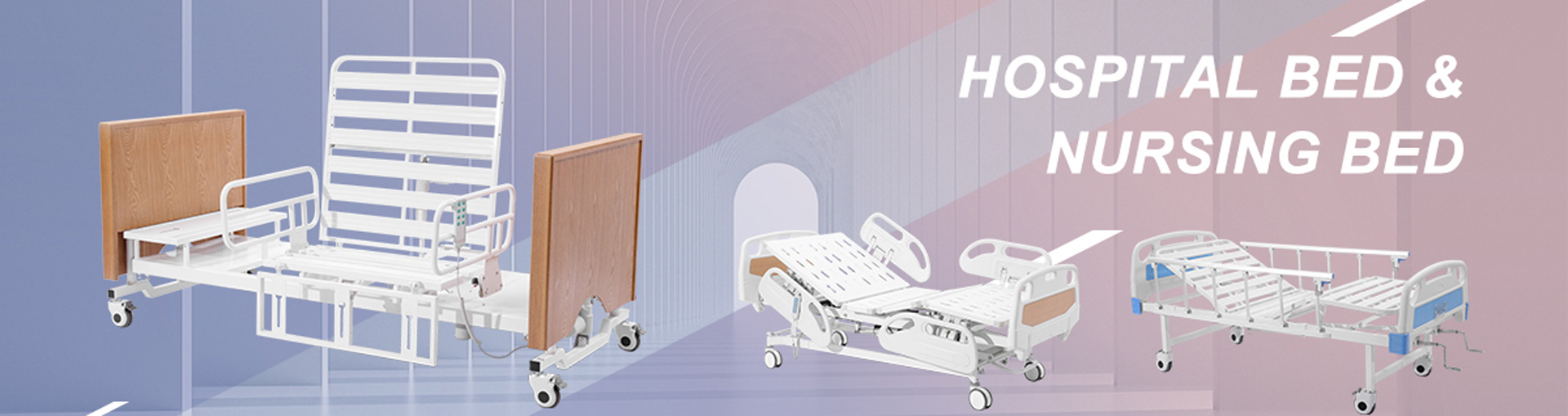
"How many ICU hospital beds does a hospital usually have" appears to be a very straightforward question. However, the complexity lies in the fact that hospital construction and planning, the availability of medical equipment, ICU designing, and hospital operational/management are all different factors that come into play and one will see that it is not simply the matter of "counting the number of beds" that constitutes this question.
If you are a member of the family of a critically ill patient, ICU beds will represent to you what the hospital's admission capacity is for all patients that require the highest level of medical attention; if you are involved in hospital administration, ICU beds are symbolic of a highly intricate medical resource distribution system; if you are in the medical equipment industry then the number of ICU beds is going to be directly related to the scale of your ICU hospital beds, ICU electric beds, intensive care beds, bedside monitors, ventilATORS, infusion pumps and other lifesupport equipment procurement.
In fact, even a 500-bed hospital may not have 50 beds in the ICU, and the concept that "10% of the hospital beds are designated as ICU beds" isn t something that is accepted worldwide as a standard. Differences in the proportion of beds in the ICU can be quite noticeable between different countries, types of hospitals, specialties, and even the different years for which statistics are given. For the public it is clear that ICU hospital bed proportion of US hospitals may vary from 13% to 16% based on the dataset and period. At the same time, hospital statistics of England, the United Kingdom between 2012 and 2021 indicate the proportion ranging approximately from 3.4% to 5.2%. There can be variation in definitions of the ICU, statistical procedures, and healthcare systems between the two countries, therefore these proportions may not be directly compared between one country and another.
If a practical answer is first of all required, we can make a rough estimate: a small hospital typically has only some dozen ICU hospital beds, a medium-sized general hospital may have 10--30 ICU beds, whereas a big general hospital, a university hospital, or a regional medical center can have 30 to 60 or more ICU hospital beds. In case a hospital has several dedicated intensive-care units, besides the adult ICU such as cardiac monitoring ICU, neurological ICU, surgical ICU, pediatric ICU, neonatal ICU, the total number of ICU beds will be higher. Yet bear in mind this is only the range used by the industry for the sake of clarity and understanding but it is not the standard of uniform configuration for any country or region.
Why can't we only look at the hospital's size when determining "how many ICU beds a hospital has"?
The total number of hospital beds is indeed an important reference indicator for judging the size of the ICU, but it is by no means the only variable.
A hospital might have 100 general inpatient beds, but because it primarily focuses on rehabilitation, long-term care, or certain low-acute specialty services, it only has a small number of ICU resources. Conversely, a specialized hospital with only around 200 inpatient beds might have a higher proportion of ICU resources if it handles a large number of complex surgeries or cardiovascular emergencies.
Furthermore, a large hospital with 500 or even 1000 general inpatient beds might refer some critically ill patients to regional medical centers, so its ICU bed ratio may not grow at a fixed rate.
This is why hospital ICU planning typically needs to consider hospital bed size, emergency room volume, surgical volume, proportion of critically ill patients, average length of stay, patient referral sources, and the hospital's regional healthcare function.
Historical research shows that an early national survey of intensive care units in the United States found that the number of ICU beds increases with the overall size of the hospital: hospitals with 100 beds or less typically had only about one ICU bed, while hospitals with more than 500 beds averaged three or more ICU beds; the national average ICU bed size at the time of the study was approximately 11.7 beds.
While this data is from an earlier period, it clearly illustrates a core principle: larger hospitals tend to have more ICU beds, but ICU hospital beds are not simply replicated at a ratio of one to ten to the total number of hospital beds.
From a pragmatic viewpoint, we wonder, on average, how many ICU beds does a typical hospital have?
Rather than viewing the policies of a particular country as the blueprint for the world, let's assume hospital size and standard operation practices as our points of departure and then derive a more natural and intuitive frame of reference.
A small hospital that is limited to about 50-150 beds altogether, would most likely have only 4-10 ICU beds if it's only taking care of a small number of critically ill patients. Some hospitals even have only a small general ICU for postoperative monitoring and short-term treatment of critically ill patients.
Middle-sized hospitals with around 150-400 inpatient beds generally have about 8-30 ICU hospital beds. The volume of surgeries, emergency visits, or the level of handling critical care services in the region are main determining factors which the number of ICU beds will approach the maximum figure in this range of numbers:
Full-size general hospitals, which have 400-800 or more inpatient beds, are likely to have 20-60 or even more ICU beds, and ICU beds may be spread out over different intensive care rooms as opposed to being kept in the same room.
It gets more complex at really big teaching hospitals, medical centers, and regional medical centers that can have several ICUs, such as a general ICU, a cardiac ICU, a surgical ICU, a neurological ICU, a burns ICU, a pediatric ICU, and a NICU, and because of these many specialty ICUs, the number of ICU beds may go from several to hundreds of ICU beds or even a much larger number of ICU beds.
Therefore, to respond to the question by saying “10” or “20” about the number of ICU beds in a typical hospital is to give an answer that does not align with the professional standard of a medical professional. A better way of wording the answer may be that the normal number of ICU beds in a hospital most often fall in the low single-digit to low two-digit range while major hospitals or medical centers can have ICU beds in the several dozens or hundreds range distributed across multiple ICU units.
What is the percentage of a hospital's total beds that are typical for ICU beds?
One survey in America reveals that, at various times and with different databases, the proportion of ICU or critical care beds was as high as 13%-16%. For instance, a research paper based on the acute care hospitals in the U.S. concluded that approximately 16.2% of hospital beds are ICU hospital beds, whereas another paper based also largely on data of American hospitals found that the median percentage of ICU/total hospital beds was about 14.7%.
If a hospital has 500 general beds, math-wise, the number of ICU hospital beds, the approximate, could be 70; for a hospital with only 200 beds, the number of their ICU beds is about 28.
But, this simple calculation is only a model or a benchmark of scale and never to be confused with hospital blueprints!
That being said, US stats are not always the same and certainly you can't directly transpose them onto the Chinese, British, and other health care systems. In fact, a study conducted in the UK showed that in 2012 ICU accounts for 3.4% of the total hospital beds, which then increased to about 4.0% of total hospital beds for that country in 2021, and eventually reached a figure of 5.2% in 2020 during the pandemic. In this case, the UK numbers clearly are much lower for ICU capacity percentage of the total compared to the US. And the different percentages are because of differences between countries in their definitions of ICU beds, hospital layouts, patient referrals systems, and critical care management.
Given this, you should first find out from what source are these data obtained when you decide to analyze the ICU bed capacity in hospitals.
ICU beds are not ordinary hospital beds, so why are their construction costs significantly higher?
Many non-professionals easily fall into a misconception: does adding an ICU hospital bed in a hospital simply mean adding an electric ICU bed?
In reality, it is far more complex than that.
A truly operational ICU hospital bed typically requires a bedside monitoring system, respiratory support equipment, infusion pumps, syringe pumps, suction equipment, oxygen and medical gas interfaces, emergency power, data systems, and other life support equipment.
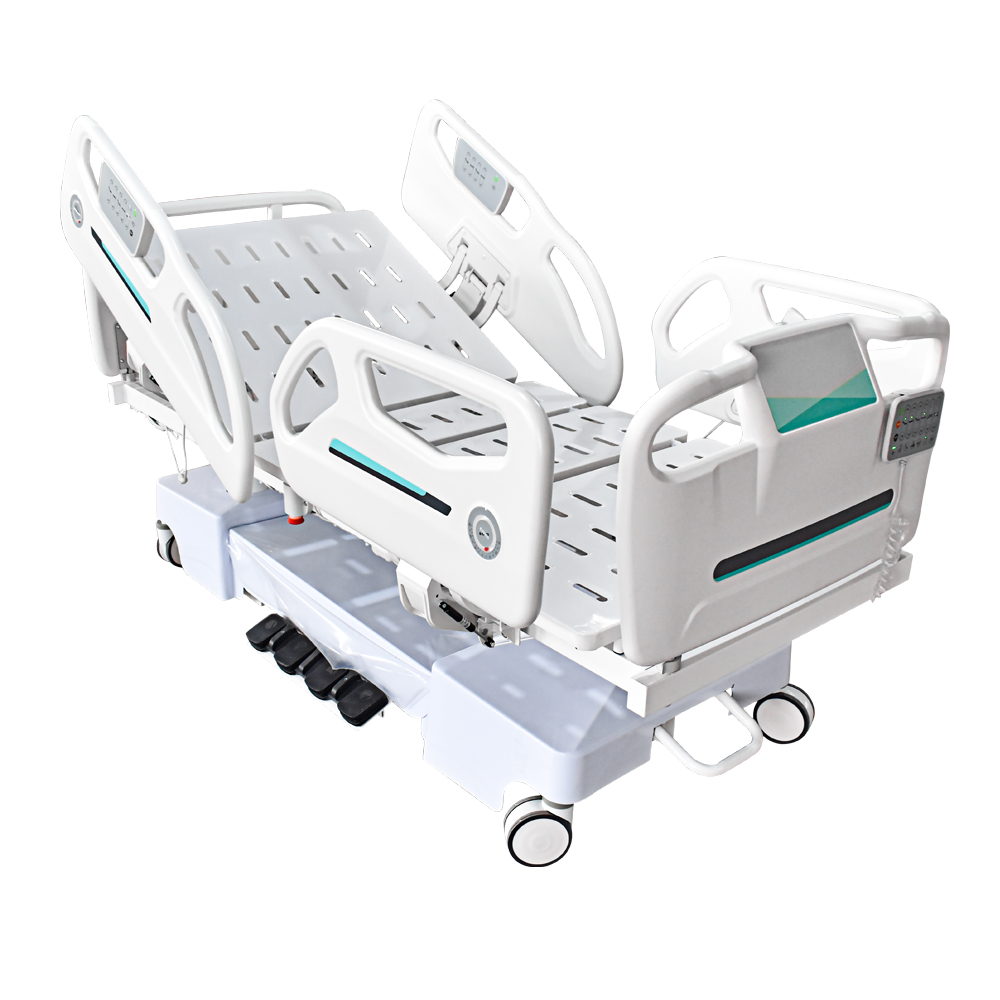
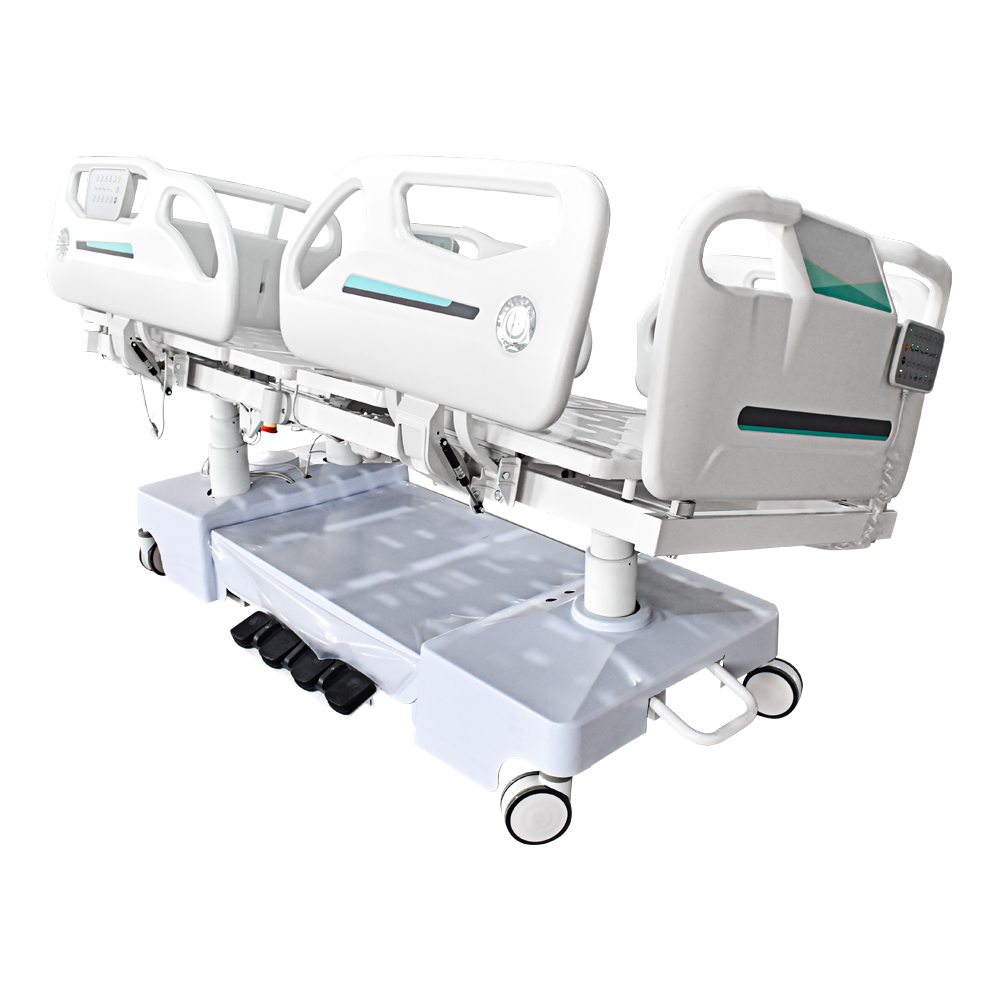
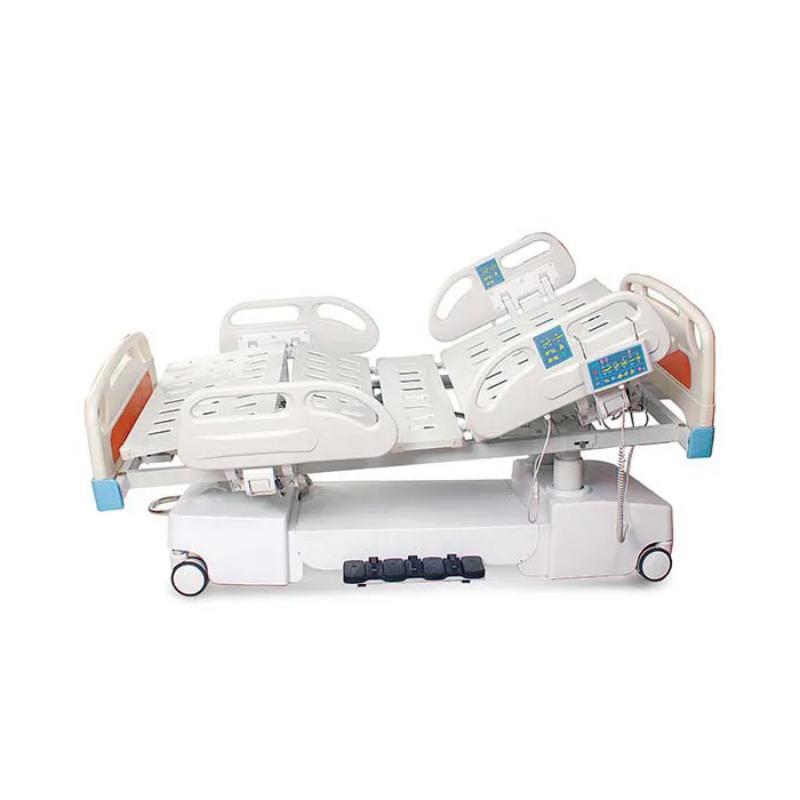
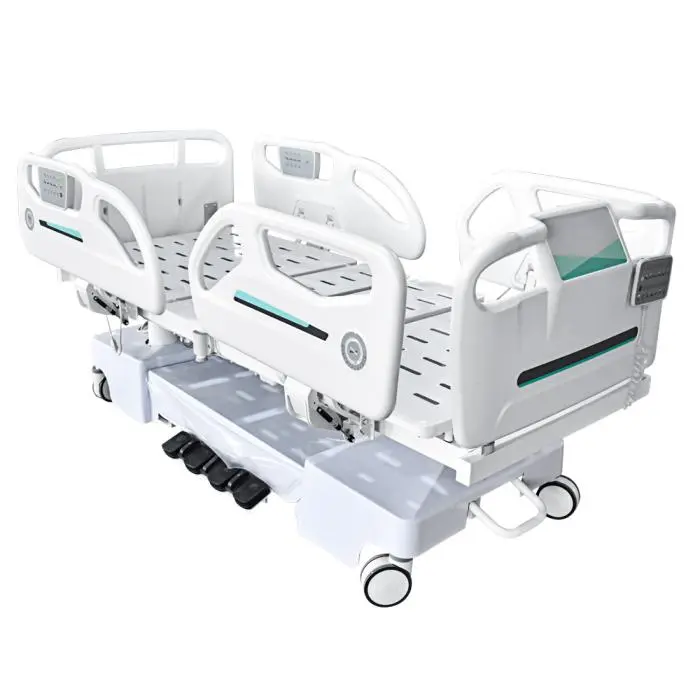
In modern intensive care environments, ICU hospital beds themselves require a high degree of electrically adjustable capabilities. A typical ICU bed may feature backrest adjustment, legrest adjustment, overall height adjustment, adaptive positioning, CPR positioning, and bed rails. Some high-end ICU beds may also integrate weighing systems, patient exit monitoring, electronic controls, and connectivity with the hospital's information system.
Therefore, an ICU bed actually represents a complete set of critical care infrastructure.
From a hospital planning perspective, if adding 10 ICU hospital beds, the hospital needs to consider more than just purchasing 10 beds; it also needs to assess the monitoring equipment, ventilators, infusion equipment, medical gas interfaces, power capacity, network communication, nursing space, and medical staff required for those 10 beds.
This is why the number of ICU beds is often a "comprehensive indicator" of a hospital's critical care capacity, rather than simply the number of pieces of furniture.
How Many Beds Can An ICU Have?
If one narrows the question from "hospital" to "one ICU unit," it will give one a more definite answer.
According to historical figures, the average capacity of a single ICU in US hospitals was 11.7 beds, with large differences in size between various types of ICUs.
A small ICU could have as few as 6-8 beds, a medium one around 10-20, and a big one up to 20 or even 30 beds.
Why is an ICU not an endless expansion?
Besides arranging beds in the ICU, it's also necessary to have adequate visibility from the nurses' station, a certain distance that the nurse can serve at a time, the physician's rounding area, placement of equipment, infection control measures, patient isolation, and emergency reviving routes.
If an ICU unit is overlarge, the patient number and the space for the nurses (nursing staff) to manage would rise, but on the upside, it might prevent low equipment and personnel (person/ personnel) utilization when the unit is extremely small, which may result from that.
Hospitals therefore frequently prefer a "multiple ICU units" option, rather than having one massive unit.
Taking an illustrative example, a large comprehensive hospital with 600 ordinary inpatient beds, that would need around 60 ICU hospital beds, might set up a general ICU, a cardiac ICU and a surgical ICU, each department being equipped with 15 to 25 beds instead of packing and cramming 60 beds into a single ICU.
Why do beds in the ICU differ according to specialties?
It is a fact that there is more than one ICU.
The different types of intensive care units that one will commonly see are: MICU (Medical Intensive Care Unit); SICU (Surgical Intensive Care Unit); CCU (Coronary Care Unit); NICU (Neonatal Intensive Care Unit); PICU (Pediatric Intensive Care Unit); and there may also be other kinds of specialized intensive care units as e.g. neurological intensive care unit, burn intensive care unit, and also intensive care units related with transplantation.
ICUs of different kinds will need their beds together with medical equipment in various ways.
A classic example would be NICUs, whose patients are little babies; their bedding requirements, temperature control, monitoring as well as the respiratory support are all very much at variance compared to those in the adult ICU (e.g. PICCU). PICUs (Pediatric Intensive Care Units) are designed to care for child patients, so the equipment should be capable of covering different ages and body sizes. In case of cardiac intensive care units, there might be a demand for higher level of the EKG (electrocardiographic) activity and circulatory support equipment.
When a hospital makes a statement like: "We have 30 beds only in the ICU," it would be very important that one understands what those 30 bed are for different types of ICU units.
What are some primary devices which require a ICU hospital bed?
An ICU hospital bed needs to have a complete setup on its side with the various devices and tools that can do the work efficiently. One of the fundamental devices, beside this bed, is the bedside monitor. It is the heart of any ICU as it helps in continuously tracking the different vital signs such as heart rate, blood oxygen saturation, blood pressure, respiratory rate, and much others that are configured in line with a patient's condition and the depth of the monitoring needed.
The other group of equipment includes respiratory support machines or rather, ventilators. Mechanical ventilation is the way to go for ailing patients who need breathing assistance, ventilators become not only life-support but also a very critical tool of the intensive care setting.
In the third place, one should think about various infusion devices. Patients under ICU care might be given a combination of different drugs, nutritional solutions, and the like; at the same time the infusion and syringe pumps, in most cases, are set up with several running devices so that different solutions can be delivered to the patient.
The fourth category is the suction apparatuses employed to deal with various secretion management situations of a patient's airway.
The fifth equipment is actually the ICU bed itself. The best quality ICU hospital beds have features such as multi angle electric adjustment and fast positioning in emergency situations.
Besides these, one also needs to keep the ICU area's requirements for a central monitoring system, emergency power supply, oxygen, compressed air, negative pressure or isolation facilities, and an information system in mind.
In fact, from a procuration angle, the question of the number of ICU hospital beds in a hospital can be reframed as the amount of the number of intensive care workstations to create.
If a hospital has 500 beds, then how many should they have?
This is perhaps one of the common examples which is often raised in the field.
This illustration purely for the purpose of illustration uses historical US data showing that about 13 per cent - 16 per cent are ICU/hospitalbeds ratio. So, if a hospital has 500 beds, the number of 500 hospital beds could probably amount to about, 65 or 80 ICU hospital beds.
An example could be the use of a ratio of 14 per cent :
500 × 14% = 70 ICU hospital beds.
This is, however, a matter of computation and not an indication of hospital design standards.
In the case where the large majority of the 500-bed hospital is general internal medicine and surgery hospital only, the actual requirements for the ICU would be much lower than the computed ICU hospital beds number. If it happens to be a major trauma or cardiac hospital, or it is a hospital which mainly performs highly complex operations, the hospital might need more resources of a higher intensity care unit as such.
A similar scenario is when a large proportion of these 500 beds is for pediatrics, neonatal care or rehabilitation then the calculation of ICU beds based upon the adult ICU ratio of 14 per cent will probably not be appropriate.
Thus, in terms of hospital planning the answer to the question "How many ICU hospital beds does a 500-bed hospital need? 1/4 120 is only a rough estimate for the first time and eventually be made on demographic features and hospital capacity.
Does having more ICU beds necessarily mean a hospital has a stronger capacity for critical care?
The number of ICU beds is an important indicator of a hospital's capacity for critical care, but it's not the only one.
A hospital with 100 ICU beds may have a lower actual operational capacity than its theoretical capacity if it lacks sufficient critical care physicians, nurses, ventilators, monitoring equipment, and medical gas systems.
Conversely, a hospital with 20 ICU hospital beds, but with an experienced critical care team, well-equipped facilities, and high bed turnover rate, may have a very strong actual capacity for critical care.
Therefore, evaluating a hospital's ICU capacity should consider at least the number of ICU hospital beds, bed utilization rate, staffing, equipment, patient demographics, critical care medical technology capabilities, and referral system.
This is also a key reason why modern hospitals are increasingly shifting their focus from "number of beds" to "effective intensive care capacity."
The number of ICU beds is also affected by public health emergencies
Recent public health events have made global healthcare systems pay more attention to ICU capacity.
In normal times, a hospital may only need to maintain a stable number of ICU beds. However, during large-scale respiratory infectious diseases, disasters, or other emergencies, hospitals may need to temporarily expand their intensive care capacity.
But expanding ICU capacity is not simply about increasing the number of beds.
Hospitals must also address issues such as oxygen supply, ventilators, monitors, infusion equipment, power, personnel, infection control, and patient zoning.
Related research in the United States also shows that the regional distribution of critical care beds is uneven, with significant differences in the density of ICU hospital beds per capita between different healthcare service areas.
Therefore, large urban medical centers may have a higher density of ICU hospital beds, while hospitals in remote areas may have fewer ICU resources and rely on referral systems to connect with regional medical centers.
FAQ: Frequently Asked Questions about the Number of Hospital ICU Beds
FAQ 1: How many ICU hospital beds does a hospital typically have?
There is no uniform standard. Small hospitals may have only a few to around ten ICU beds, medium-sized hospitals may have about 10-30, and large general hospitals may have 20-60 or even more; large medical centers with multiple specialized ICUs may have dozens or even hundreds of ICU hospital beds.
FAQ 2: How many ICU beds does a small hospital with 100 beds need?
It might only have around 4-10, or it could be more or less. Historical US research shows that hospitals with 100 beds or less typically have only one ICU unit. The actual number depends on whether the hospital handles acute and critical care, complex surgeries, and regional referrals.
FAQ 3: What is the difference between ICU beds and regular hospital beds?
ICU hospital beds are for critically ill patients and typically have higher electric adjustment capabilities, weight-bearing capacity, and emergency operation functions. They also need to be equipped with bedside monitoring, respiratory support, infusion equipment, and medical gas systems. Regular hospital beds mainly meet the bed rest and nursing needs of ordinary hospitalized patients. There are significant differences in function and usage environment between the two.
FAQ 4: Is it normal for a hospital to have multiple ICUs?
This is perfectly normal. Large hospitals typically have multiple ICU units, such as general ICU, cardiac ICU, surgical ICU, neurological ICU, pediatric ICU, and NICU, depending on the patient type. A US hospital-level study showed that hospitals with critical care specialists had a median of 2 ICU units, while hospitals without such specialists had a median of 1.
FAQ 5: What percentage of a hospital's total beds is a reasonable proportion for ICU beds?
This varies greatly between countries and hospital types. Some publicly available research data in the US shows that ICU hospital beds account for approximately 13%–16% of hospital beds, while in England, UK, it was approximately 3.4%–5.2% between 2012 and 2021. Therefore, a single percentage cannot be used as a standard for the construction of all hospitals.