

For users who frequently engage in outdoor activities, standard electric wheelchairs often struggle to navigate terrain such as grass, gravel, dirt paths, slopes, and uneven or potholed surfaces. Consequently, all-terrain electric wheelchairs—designed with a greater emphasis on outdoor performance—have recently appeared on the market. Upon seeing these products, many consumers wonder: if they are truly "all-terrain," why aren't the rear wheels made exceptionally large, like those on off-road vehicles? Does a larger tire necessarily mean superior obstacle-crossing and climbing capabilities?
In reality, all-terrain electric wheelchairs do exist, and their design philosophy differs significantly from that of standard models. However, "all-terrain" capability is not simply a matter of installing oversized tires. A wheelchair's outdoor mobility depends on the integrated performance of multiple components, including the tires, drive motors, suspension, ground clearance, center of gravity, and control system. Therefore, rear wheel sizes are kept within a reasonable range rather than being increased indefinitely.
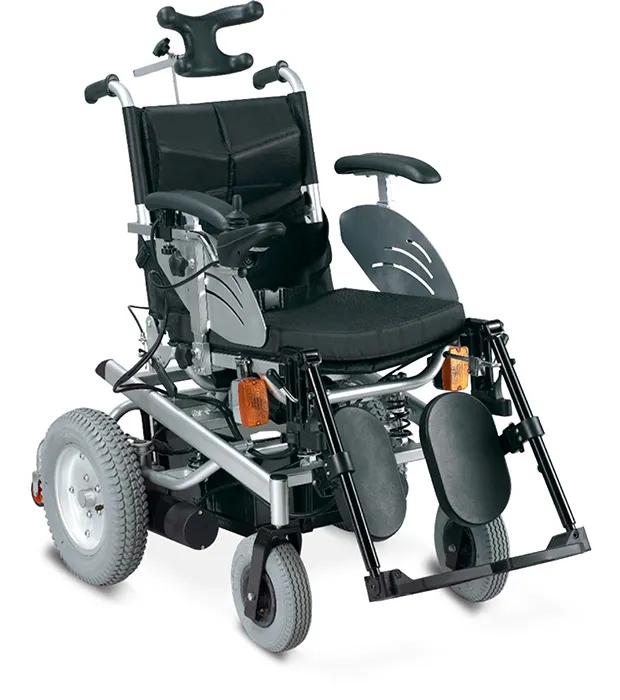
Do all-terrain electric wheelchairs exist?
Yes, they do. All-terrain electric wheelchairs are specifically designed for outdoor environments that challenge standard models—such as grass, gravel, dirt paths, slopes, paved surfaces, and roads with potholes or significant changes in elevation.
Standard electric wheelchairs prioritize indoor maneuverability, compact dimensions, tight turning radii, and ease of daily use; thus, their tires and chassis do not require reinforcement for complex terrain. In contrast, all-terrain electric wheelchairs must address three key challenges: maintaining sufficient tire traction, clearing obstacles of a certain height, and ensuring stability on slopes and uneven surfaces.
Currently, some all-terrain power wheelchairs feature drive wheels around 12–15 inches in diameter, paired with front wheels of 8 inches or larger, suspension systems, and high ground clearance. Some heavy-duty models utilize drive wheels exceeding 15 inches. For instance, certain all-terrain models on the market use 12-inch rear wheels combined with dual motors (rated at approximately 500W) and front suspension, while heavy-duty models may employ 14- to 15-inch (or larger) pneumatic drive wheels, higher-power dual motors, and full-vehicle suspension systems. This demonstrates that all-terrain power wheelchairs are not merely conceptual products; rather, they have established a distinct market segment.
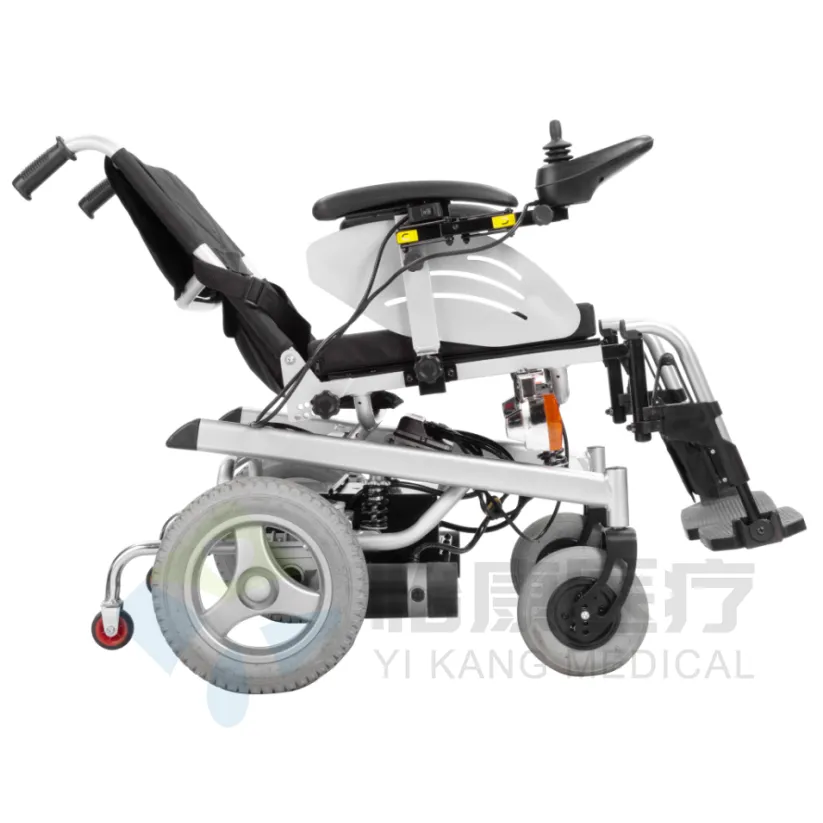
Why aren't the rear wheels of all-terrain electric wheelchairs exceptionally large?
The primary reason is that an electric wheelchair is not an off-road vehicle; it must balance ergonomics, maneuverability, weight, battery range, and transportability.
In terms of overcoming obstacles, large tires do offer advantages. A larger diameter makes it easier for the tire to roll over bumps, grooves, and stones rather than striking them directly. For instance, when encountering a small obstacle of a given height, a 15-inch tire offers significantly better geometric clearance than a 10-inch tire.
However, increasing tire size also introduces a series of issues.
First, large tires increase the vehicle's overall height. If the drive wheel size increases from 12 inches to 20 inches, the tire radius grows by approximately 100 mm. The frame, seat, footrests, and suspension structure would all require redesigning; otherwise, the seat height and center of gravity would rise, negatively affecting ease of entry/exit and stability on slopes.
Second, large tires generally entail greater weight and rotational inertia. Since power wheelchairs are battery-powered, the added weight of the tires and frame inevitably translates to higher energy consumption. If motor power and battery capacity must also be increased to drive larger tires, the vehicle's total weight rises further.
Third, large tires increase the vehicle's physical footprint. Electric wheelchairs are used in homes, hospitals, shopping malls, and vehicles, so their width and length cannot be increased indefinitely. Excessively large rear wheels require larger wheel housings, suspension components, axles, and frame structures, all of which consume more space and reduce the product's day-to-day practicality.
Consequently, manufacturers typically select a reasonable tire size rather than simply pursuing "bigger."
Does a larger tire mean the electric wheelchair has more power?
Not necessarily; in some cases, large tires actually place higher demands on the drive system.
A wheel's theoretical tractive force is related to the motor's output torque and the wheel radius, and can be expressed simply as:
F ≈ T/r
Where F is the theoretical tractive force, T is the output torque at the wheel, and r is the wheel radius.
If the motor's output torque remains constant, increasing the wheel radius actually causes the theoretical tractive force at the rim to decrease. Therefore, when increasing tire size from 12 inches to 18 inches, maintaining or enhancing driving force requires compensation through higher motor torque, a more optimized reduction gear mechanism, or a more efficient drive system.
This is why a genuine all-terrain power wheelchair does not simply increase tire size; instead, it simultaneously upgrades the motor, controller, reduction mechanism, and battery system.
The same applies to climbing ability. A power wheelchair with 15-inch tires does not necessarily outperform a model with 12-inch tires in climbing. Actual climbing performance is influenced by factors such as user weight, the wheelchair's total weight, battery charge level, tire traction, the surface material of the slope, and motor output.
Evaluating All-Terrain Electric Wheelchairs: Look Beyond Rear Tire Size
If you are planning to purchase an all-terrain electric wheelchair, it is recommended to focus on the following parameters:
First, consider tire size and tread pattern. Larger drive wheels facilitate obstacle crossing, while wider tires improve traction on soft ground. Different terrains—such as grass, gravel, and mud—require different tread patterns, so comparing tire diameters alone is insufficient.
Second, consider chassis ground clearance. Even with large tires, a low-slung frame risks bottoming out on rocks or deep ruts. For outdoor electric wheelchairs, a ground clearance of 100 mm or more provides greater structural clearance for complex terrain, though the overall vehicle design must also be taken into account.
Third, consider the maximum obstacle-crossing height. This is a key indicator of actual mobility. While some all-terrain models boast obstacle-crossing heights of 50–100 mm or more, testing conditions vary by manufacturer; therefore, one should not rely solely on advertised figures but also understand the testing methods and intended use cases.
Fourth, consider the maximum climbing angle. Some outdoor electric wheelchairs offer a rated climbing capability of around 10°–15°, with high-performance models capable of even steeper inclines. However, in real-world use, steeper slopes place greater demands on tire traction, drive torque, and the vehicle's center of gravity; one should not simply operate the chair at its maximum rated limits for extended periods.
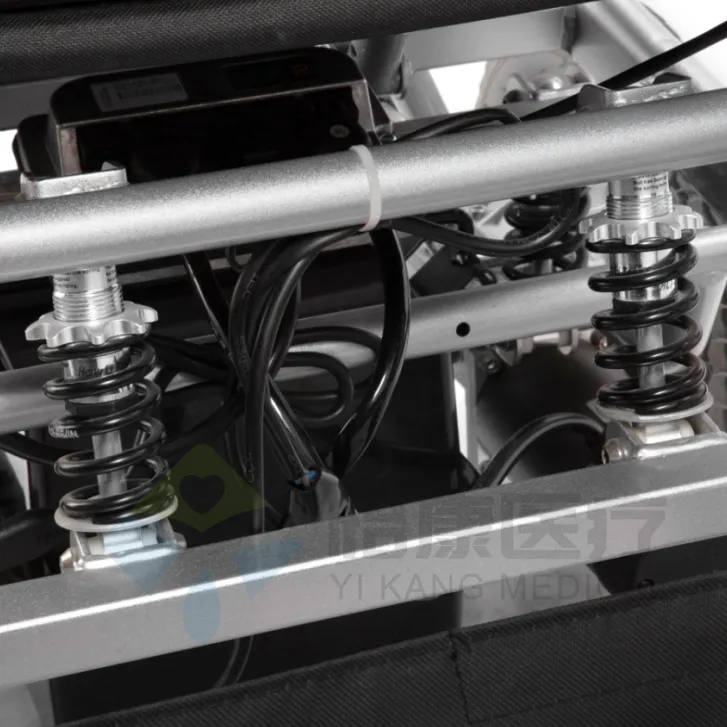
Fifth, consider the suspension system. This is a major distinguishing feature between all-terrain electric wheelchairs and standard models. Suspension systems help maintain tire contact with the ground on uneven surfaces while reducing the impact transmitted from the road to the frame and seat. For users who frequently travel over gravel, grass, or rough terrain, the suspension is just as critical as tire size.
Why shouldn't the front wheels of an all-terrain electric wheelchair be too small?
When evaluating all-terrain electric wheelchairs, many people focus solely on the rear wheels; however, the front wheels play an equally important role in obstacle-traversal capabilities.
As the wheelchair moves forward, the front wheels are the first to encounter obstacles. If the front wheels are too small, they are more likely to experience significant impact—or even get stuck—when facing thresholds, rocks, or ruts. Consequently, some all-terrain models utilize front wheels that are 8 inches or larger and incorporate suspension systems to improve the wheels' ability to track the terrain.
From this perspective, the wheel configuration of an all-terrain power wheelchair is an integrated system. The rear wheels handle propulsion and primary traction, while the front wheels manage steering and obstacle clearance; both must work in concert with the frame, suspension, and chassis.
Therefore, a model featuring 15-inch rear wheels but tiny front wheels and low ground clearance is not necessarily better suited for outdoor use than a model with 12-inch rear wheels that boasts a well-balanced wheel setup and a robust suspension system.
What are the key industry pain points regarding all-terrain power wheelchairs?
A major issue in the current market is that consumers are often swayed by isolated specifications. For instance, they might assume "large tires" guarantee superior off-road performance, "high-power motors" ensure excellent climbing ability, or a "15° climbing rating" means the vehicle can safely navigate any 15-degree slope.
In reality, an electric wheelchair operates as a cohesive power system. A wheelchair might have a 500W motor, but if the vehicle is heavy and the tires lack grip, it can still slip on wet grass or soft mud. Conversely, even with large tires, insufficient motor torque can result in a lack of power.
Therefore, when developing all-terrain electric wheelchairs, manufacturers should avoid simply stacking specifications. Instead, they should establish comprehensive performance metrics—covering factors such as maximum load capacity, tire size and width, ground clearance, maximum obstacle-traversal height, climbing ability, range, total vehicle weight, and turning radius. Buyers should select products based on the intended operating environment. If the chair is primarily for use on city streets and park lawns, there is no need for a heavy-duty model. If it will frequently traverse gravel paths, slopes, or rural roads, priority should be given to suspension, traction, ground clearance, and the drive system. For soft terrain such as sand or mud, tire width and ground pressure are critical factors.
FAQ
Q1: Do all-terrain power wheelchairs really exist?
Yes, they do. All-terrain power wheelchairs are specifically designed for outdoor environments such as lawns, gravel paths, dirt roads, slopes, and uneven terrain.
Q2: Is "bigger is better" when it comes to rear wheels on all-terrain power wheelchairs?
Not necessarily. While large tires aid in overcoming obstacles, they also increase weight, overall dimensions, and motor load; therefore, tire size must be properly matched with the power system, suspension, and frame.
Q3: What size rear wheels are typically used on all-terrain electric wheelchairs?
Sizes vary significantly by model; common drive wheel sizes range from 10 to 15 inches, though some heavy-duty models may use drive wheels larger than 15 inches.
Q4: What factors determine the performance of an all-terrain electric wheelchair?
In addition to rear wheel size, key factors include ground clearance, maximum obstacle-climbing height, climbing angle, tire traction, suspension, motor torque, maximum weight capacity, and driving range.
Q5: Can standard electric wheelchairs be used on lawns and gravel paths?
Some models can handle short distances on such surfaces; however, if you frequently travel over grass, gravel, mud, or slopes, it is recommended to choose a dedicated all-terrain electric wheelchair for superior mobility and stability.