
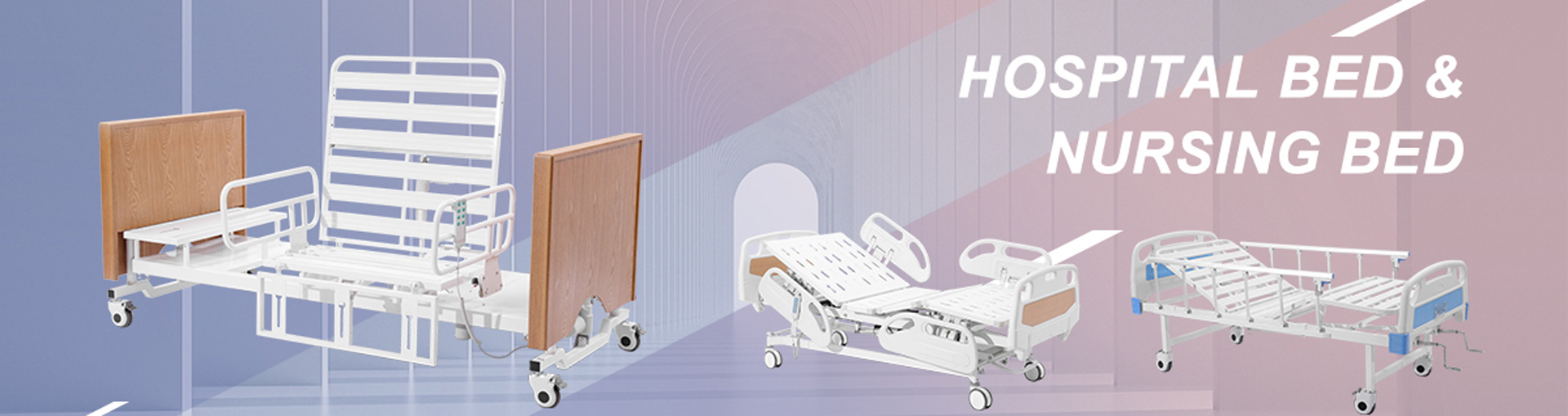
With the aging of the global population and the growing number of patients with chronic diseases, those recovering from surgery, and people requiring long-term bed rest, significant changes in the design of medical care equipment is inevitable.
Hospital beds used to be considered merely as the basic infrastructure to support patient rest and recovery.
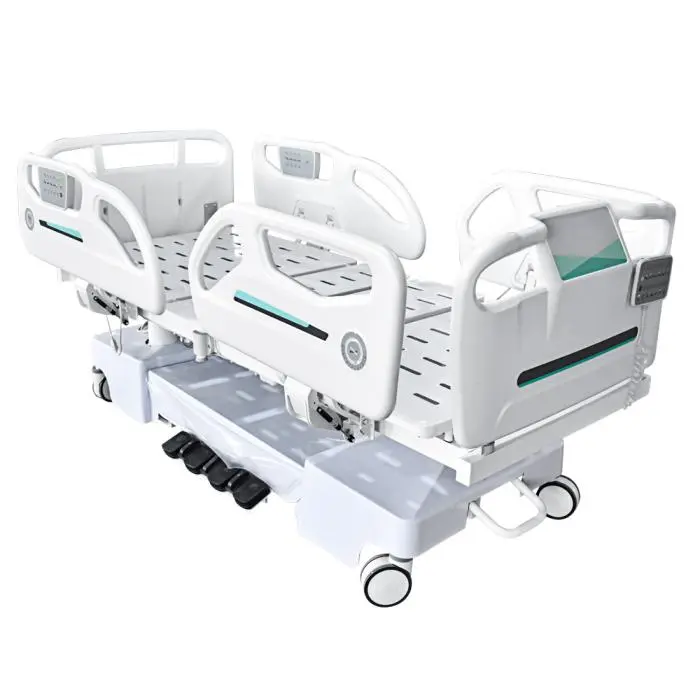
Nowadays though, hospital beds are regarded as important assistive devices that greatly affect the patient's comfort, the efficiency of care, and rehabilitation outcomes. It is no wonder that electric medical beds are becoming more and more popular in hospitals, rehabilitation centers, and home care not only for their intelligent adjustability, safe design, and easy to operate functions but also for the comfort they bring to the users.
Many consumers raise the same basic question when buying a hospital bed "Can the hospital bed be raised and lowered?"
This query indicates a lack of information and misunderstanding in the consumer's mind. There are many consumers who think that hospital beds provide just back adjustment or that the adjustment of bed height is a luxurious feature not an essential one in a hospital bed.
Actually, nowadays many electric hospital beds are capable of various electric height adjustments where the bed height can be raised or lowered is one of the major features of these models.
Patients in long-term care using standard bed height beds face multiple challenges. Care workers need to do so many things like turning patients, bathing them, changing bed linens, giving the patient intravenous treatment, etc.
If the height of the bed is fixed they have to work on bent legs continuously for which their back and muscles will get affected and will get injured over time. Fixed-height bed poses a risk to the patient's safety at the moment they get in or out of bed, especially for the elderly, people with minimal mobility, and those who have been operated and are recovering.
From the point of view of modern healthcare, changing the bed height is as important as providing a comfortable and stress-free care environment.
Through the right electric medical bed height modification can be a great relief for the physical strength of the caretakers and an effective time-saver besides being also a great enabler and safety device if the patient needs to sit up, move, and do their rehabilitative activities.
Therefore, the existence of the height adjustment function is a very prominent feature for a product that is considered to be of good quality.
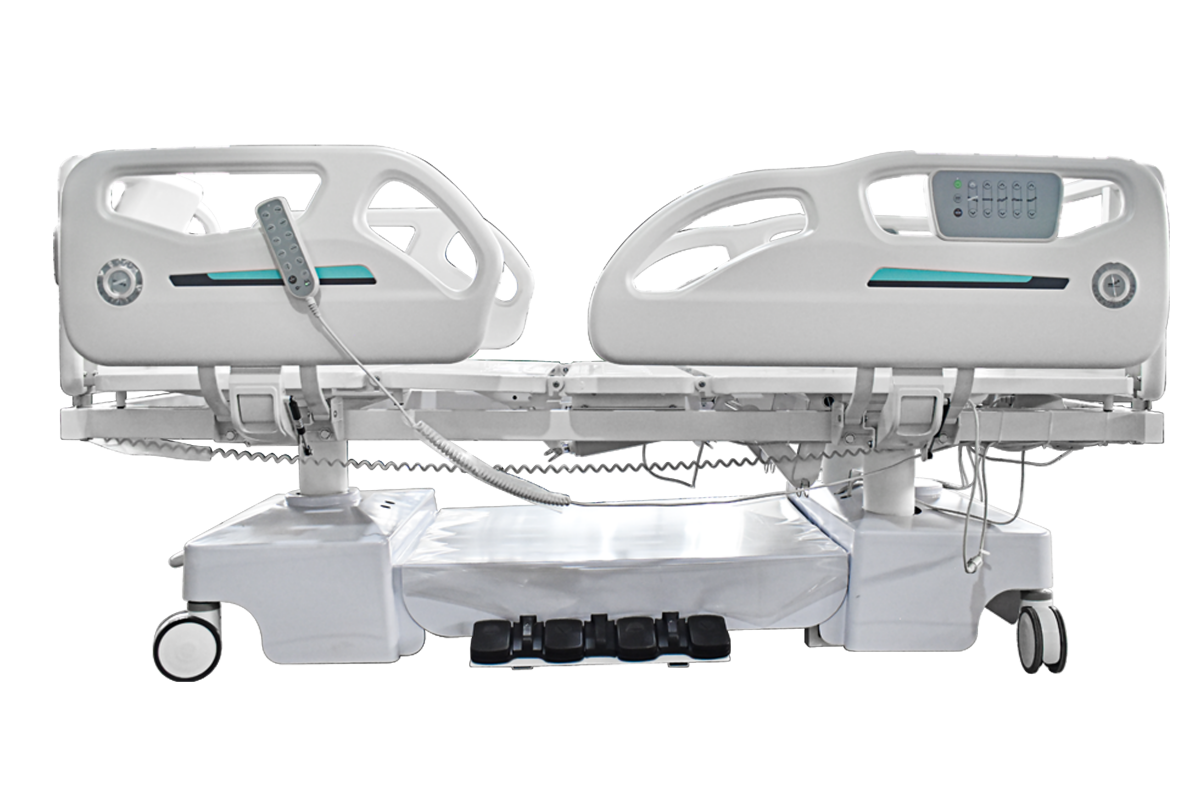
Can electric hospital beds be raised and lowered?
That's up to you if you like to decide but you should know that there are certain varieties of lifting mechanisms available.
In fact, electric hospital beds can be raised and lowered and the particular type of lifting will depend on the model that you have. Basically, an electric bed can be categorized by its functionalities into basic, functional, and super-functional smart versions where each is supporting different kinds of height adjustments.
The simplest lifting feature is the height adjustment of the bed in total. That means the full base of bed as well as the platform on which the mattress is placed will move upward or downward together. This is mostly for the assistance by nurses to patients and transfers of patients.
For example, when a caregiver has to clean up the patient, change a sheet, or do a physical examination, he or she may use the remote controller to set the bed to a convenient working height, on the other side, when the patient is moving to a wheelchair or walker, the bed height can be set at a lower level so that a patient's feet reach the floor more safely, and at the same time it ensures their safety.
Besides total height adjustment, another type of elevation is the one of the back rest and leg rest respectively.
When a back rest elevation is made, a patient can change the posture from complete lying to semi-reclined, which would allow them to eat, talk with others, read besides giving them comfort of getting rid of the feeling stuck.
Raise a footrest to put the lower part of your body in the right position; this will offer your feet better support if you suffer from swelling. This is also the preferred position when one recovers from a surgical operation or bedridden for a long.
In addition to the height adjustment of the whole bed and the back support and footrest raising functions, some of the more advanced electric medical beds also allow a fully bed tilting function—Such positions (the Trendelenburg: head-down, feet-up and the reverse Trendelenburg are used a lot in hospitals as well as in rehabilitation centers and professional care environments (head-up, feet-down).
Accordingly, when buying an electric bed you can't rely just on the product's name, you have got to check the detailed technical characteristics. It is worth noticing that some products that are simply defined as electric hospital beds may be lacking an overall height adjustment function while offering only head and footrest adjustments.
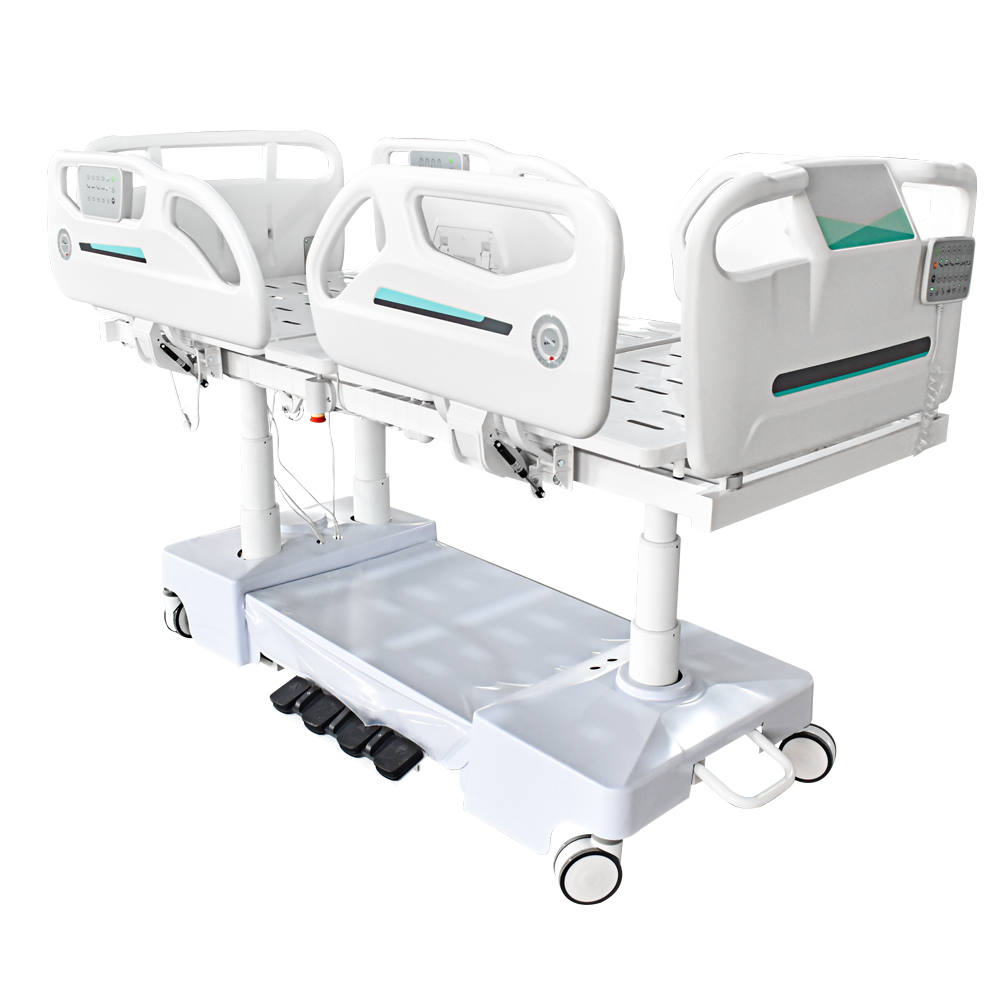
What is the basic operation of the raising mechanism of an electric medical bed?
An electric hospital bed is automatically capable of lifting and lowering, which is based on a motor power system, electric linear actuators, and a mechanized support structure.
Electric hospital beds use one or more electric actuators, while ordinary manual beds are without that feature. As soon as the patient or the caregiver touches the hand controller button to raise, the control system will turn on the motor which makes the actuator move either out or in and so the bed frame height will change.
The functional capabilities of the bed can be varied as per the number of motors used and these can be as follows:
Sleep comfort two-motor hospital beds provide basic comfort functions that mainly serve the backrest and legrest, suitable for fundamental caregiving only;
Three-motor electric hospital beds add up overall height control to its already diverse features, thereby matching various home and professional use conditions;
An even greater four-motor model can be equipped with a tilting option (Trendelenburg/Reverse Trendelenburg) making them suitable for advanced healthcare scenarios.
A typical lifting range for electric beds in stores is anywhere between 40-80 centimeters, but exact heights depend on design, patient demands, and type of product (home/hospital care). Whereas the home-care models are made with a low minimum height to prevent falls; on the contrary, the hospitals’ bed models are designed to provide maximum convenience for the caregivers.
The quality of the motor is another important component to consider regarding the durability of the electric mattress bed. The manufacturers of high-standard products usually install very little noised motors, and also put in safety mechanisms that protect from overloading, pinching, etc., along with well-designed control panels to prevent any mishaps over time.
How height adjustment is a gamechanging feature in electric hospital beds?
Lifting mechanisms are a major point of interest in electric medical beds and many buyers only care if a bed has this feature or not, without realizing what the benefits are of that feature.
Apart from that, the main beneficiaries are the caregivers as well, who suffer greatly from the lifting of patients due to the constant bending.
The caregiver’s role requires carrying out the same task day after day which includes patients repositioning, their position adjustment, and sometimes the provision of new nursing care supplies. However, if there is a fixed bed height, the caregivers must stoop to accomplish those tasks. That kind of wrong posture over time is a real strain on the lower back.
The electric medical beds can be adapted to allow the height of the bed the best suits the caregiver. When they have to deliver nursing service, raising the height up to their elbow level will be most convenient and if the patient needs to get in/out of bed, then lowering the bed will make it safer.
Besides, the height regulating ability gives more freedom to the patient too.
Movement in and out of bed as well as transferring are essential tasks for bedridden people and the elderly. When the bed height of a patient can be adjusted to the right level, the patient can be assisted in moving the legs or the back up/down by the means of a rail, a stick, or a caregiver.
To summarize, the height adjustment feature not only helps with caregivers but also with the comfort of the patient and their safety.
Changes in the height can help in the improvement of the patient's comfort. For example, a patient suffering from heart or lungs problems can sit upright to ease breathing, while an elderly patient might need more space for their legs. By having an electric adjustment at one's disposal, a bed can be adapted for both the patient and the caregiver for maximum comfort.
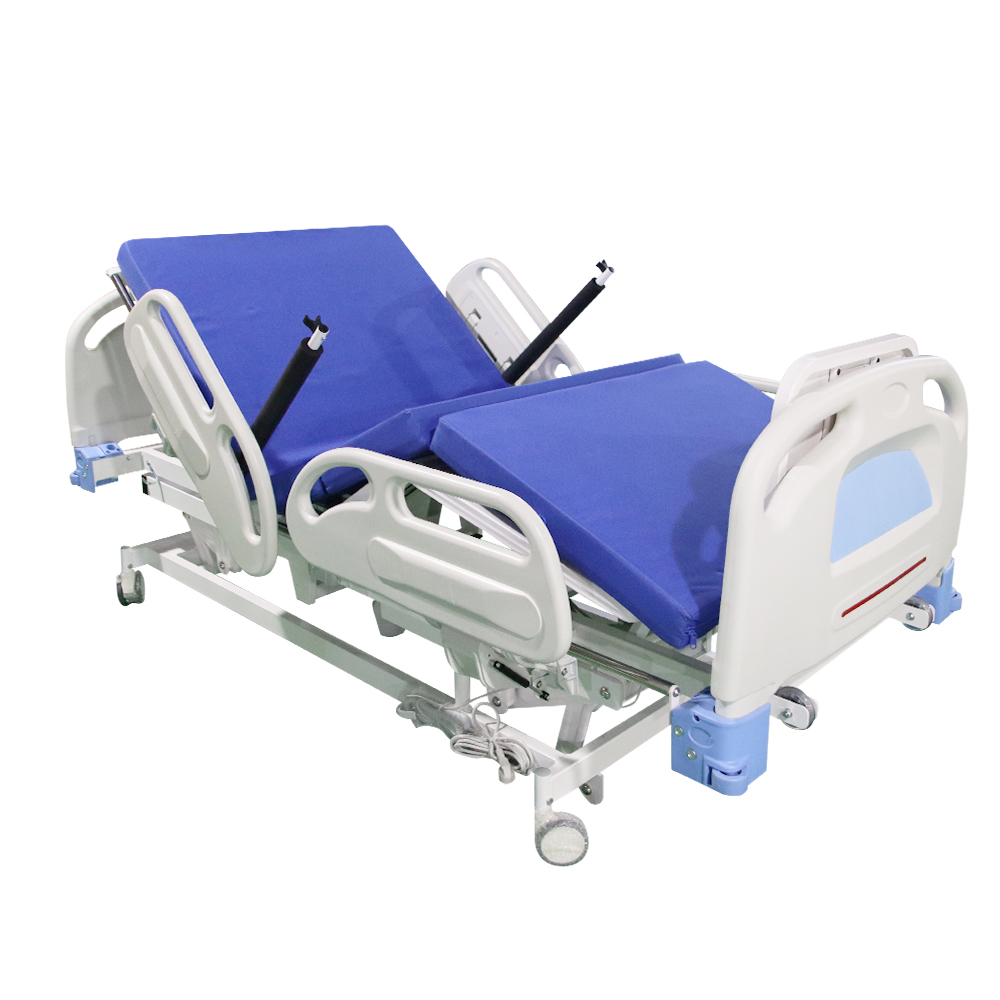
What are the common types of lifting and adjustment functions for electric hospital beds?
I. Overall Bed Height Adjustment
Overall height adjustment is a key feature of modern electric hospital beds and a major distinction from standard hospital beds.
This function uses motors to move the entire bed frame up and down, allowing the bed surface height to adapt to different scenarios. For example, in a hospital setting, nurses can raise the bed to a height suitable for caregiving, thereby reducing the need to bend over repeatedly; in a home setting, the bed can be lowered to make getting in and out safer for the patient.
Typically, the minimum height of an electric hospital bed is around 40 cm, while the maximum height ranges from approximately 70 cm to 80 cm. Specific specifications depend on the product design and the intended usage environment.
II. Backrest Adjustment
Backrest adjustment is one of the most frequently used functions.
Patients confined to bed for long periods may experience discomfort if they remain lying flat constantly. Electric adjustment of the backrest angle allows the patient to adopt a semi-seated position, improving their experience while eating, communicating, and resting.
Most electric medical beds offer a backrest adjustment range of approximately 0° to 70°, though this varies by product.
III. Leg Elevation
Leg adjustment is primarily used to improve lower-limb support and comfort.
For post-operative, elderly, or bedridden patients, properly elevating the legs helps adjust body posture and reduce localized pressure.
Some electric hospital beds also feature knee elevation, allowing the legs to bend more naturally for enhanced comfort.
IV. Overall Tilt Function
Overall tilting is a more advanced electric adjustment function.
This feature is mainly used in professional medical settings to assist patients in achieving specific body positions. It is particularly valuable for patients requiring intensive care or specialized rehabilitation.
How will you know if an electric hospital bed with lifting functionality is a quality design?
If one has to be lifted frequently, a hospital bed is just not for that situation. There are a number of design factors to examine thoroughly before judging.
First thing is to think about the lifting range. If a bed is too limited in the lifting capacity, that might prevent it in performing most caregiving tasks while an overly broad lifting range adds the bed's structure a lot of complexity. The right choice is determined by the patient’s typical environment and lifestyle.
Second, determine the weight-bearing capability. Besides the weight of the patient a bed also needs to support the pressure generated from the caregiving activities e.g. repositioning and turning which may be quite heavy. A typical model handles about 330 to 550 lbs (150-250 kg), and some stronger models can hold heavier loads for instance over 550 lbs (250 kg).
Another point is stability. The smoothness of a moving surface, silent running of the motor and no perceptible sways are some of the characteristics that contribute to a pleasant long lasting bed experience.
Control panels are also a factor. Top-grade electronic bed frames normally include very user-friendly controls with clear labeling, enabling patients or carers to perform all bed function modifications speedily.
What are the advantages of electric medical beds over standard hospital beds?
Although traditional hospital beds are usually more affordable, since their structure is very low, their functional limitation is rather extensive. Heights that are not able to change as one wish and a requirement of manually adjusting the bed can be very problematic in situations of extended care.
Electric hospital beds offer the main advantage of automatic adjustment.
A patient can, for instance, choose his/her desired position, while a caregiver can easily make a bed configuration if so required. In addition to being much safer for patients, this type of bed is also more comfortable since no heavy lifting is needed to make the bed as desired for the patient.
Eco friendly hospital bedrooms come with a variety of added features such as electric medical beds:
Adjustable bed height;
Separate controls for the head and foot section of the bed;
Optional safety side rails;
Highly durable bed frames;
Quiet motor systems.
Thanks to these features, a person who is in bed for long periods of time may notice a big difference in their comfort and well-being during the day.
What is on a family’s mind while getting an electric hospital bed?
Home healthcare is becoming more and more common and thus, a family can get an electric hospital bed for a member of their family who requires it. However, a home setting is completely different from that of a hospital so the purchase needs to be made considering the particular situation.
Firstly, the room dimension. If you want your electric medical bed, you need to be at least 90 cm long and 200 cm wide or 100 cm to 200 cm. It is wise to measure the available area before making an informed purchase.
Secondly, patient’s condition. In case the patient can get up for just a few days only, maybe an inexpensive hospital bed with minimal functions is okay. Whereas if the person has to be in bed for a long time, then the kind of hospital bed that is capable of adjusting the full length of the bed and has multi-degree angles is recommended.
Thirdly, after-sales service.
Electric machines have moving parts and they are prone to breakdown hence manufacturers who have an extensive production background accompanied with a complete after-sales service package are preferable.
Common FAQs: Questions About the Height Adjustment Function of Electric Hospital Beds
FAQ 1: Do all electric hospital beds support full-bed height adjustment?
No. Some entry-level models only support electric adjustment of the back and leg sections; the ability to adjust the overall bed height is typically a feature found on higher-end models. Please verify the product specifications before purchasing.
FAQ 2: What is the typical height adjustment range for electric medical beds?
The common height adjustment range is approximately 40 cm to 80 cm, though this varies by model; the choice should be based on the patient's specific needs.
FAQ 3: Is it necessary to purchase an electric hospital bed with height adjustment for home care?
If the patient is bedridden for the long term, has limited mobility, or requires frequent care from family members, an electric hospital bed with height adjustment is usually the better choice, as it reduces the physical strain of caregiving and enhances safety.
FAQ 4: Are electric hospital beds safe during height adjustment?
Electric hospital beds manufactured by reputable companies are typically equipped with stable structures, motor protection, and safety control systems, ensuring a high level of safety during normal use.
FAQ 5: What is the typical lifespan of an electric medical bed?
The lifespan depends on product quality, frequency of use, and maintenance. With proper maintenance, a high-quality electric medical bed can typically meet caregiving needs for many years.